Downsampling Theorem (Aliasing Theorem)
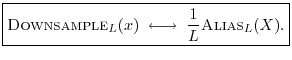
Theorem: For all
 ,
,
Proof: Let
![$ k^\prime \in[0,M-1]$](http://www.dsprelated.com/josimages_new/mdft/img1440.png) denote the frequency index in the
aliased spectrum, and
let
denote the frequency index in the
aliased spectrum, and
let
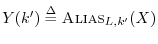 . Then
  is length
  ,
where
,
where  is the downsampling factor. We have
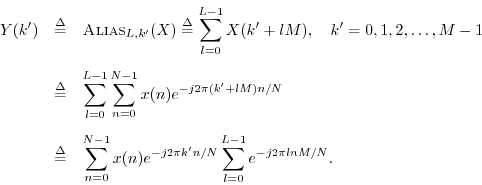
Since  , the sum over
  becomes
![$\displaystyle \sum_{l=0}^{L-1}\left[e^{-j2\pi n/L}\right]^l =
\frac{1-e^{-j2\p...
...ht) \\ [5pt]
0, & n\neq 0 \left(\mbox{mod}\;L\right) \\
\end{array} \right.
$](http://www.dsprelated.com/josimages_new/mdft/img1447.png) effectively
samples
effectively
samples  every samples. This can be expressed in the
previous formula by defining
every samples. This can be expressed in the
previous formula by defining
 which ranges only over the
nonzero samples:
which ranges only over the
nonzero samples:
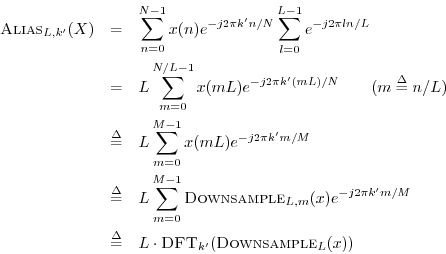
Since the above derivation also works in reverse, the theorem is proved.
An illustration of aliasing in the frequency domain is shown in Fig.7.12.
Illustration of the Downsampling/Aliasing Theorem in Matlab
>> N=4;
>> x = 1:N;
>> X = fft(x);
>> x2 = x(1:2:N);
>> fft(x2)                         % FFT(Downsample(x,2))
ans =
    4   -2
>> (X(1:N/2) + X(N/2 + 1:N))/2     % (1/2) Alias(X,2)
ans =
    4   -2
Next Section:
Zero Padding Theorem (Spectral Interpolation)
Previous Section:
Stretch Theorem (Repeat Theorem)