Euler's Identity
Since
 is the algebraic expression of
  in terms of its
rectangular coordinates, the corresponding expression in terms of its polar
coordinates is
in terms of its
rectangular coordinates, the corresponding expression in terms of its polar
coordinates is

There is another, more powerful representation of in terms of its
polar coordinates. In order to define it, we must introduce Euler's
identity:

A proof of Euler's identity is given in the next chapter. Before, the only algebraic representation of a complex number we had was
, which fundamentally uses Cartesian (rectilinear) coordinates in
the complex plane. Euler's identity gives us an alternative
representation in terms of polar coordinates in the complex plane:

 the polar form of the complex number
, in contrast with the rectangular form . Polar
form often simplifies algebraic manipulations of complex numbers,
especially when they are multiplied together. Simple rules of
exponents can often be used in place of messier trigonometric
identities. In the case of two complex numbers being multiplied, we
have
the polar form of the complex number
, in contrast with the rectangular form . Polar
form often simplifies algebraic manipulations of complex numbers,
especially when they are multiplied together. Simple rules of
exponents can often be used in place of messier trigonometric
identities. In the case of two complex numbers being multiplied, we
have

A corollary of Euler's identity is obtained by setting
 to get

 , and 0, together with the elementary operations of addition,
multiplication, exponentiation, and equality, all appear exactly once.
, and 0, together with the elementary operations of addition,
multiplication, exponentiation, and equality, all appear exactly once.
For another example of manipulating the polar form of a complex number,
let's again verify
 , as we did above in
Eq.
, as we did above in
Eq. (2.4), but this time using polar form:

 by
by  wherever it occurs. This implies
 ,
as used above. The same result can be obtained by using Euler's
identity to expand
into
,
as used above. The same result can be obtained by using Euler's
identity to expand
into
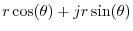 and negating the imaginary part
to obtain
and negating the imaginary part
to obtain
 ,
where we used also the fact that cosine is an even function
(
,
where we used also the fact that cosine is an even function
(
 ) while sine is odd
(
) while sine is odd
(
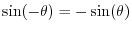 ).
).
We can now easily add a fourth line to that set of examples:
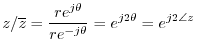
 for every
  .
.
Euler's identity can be used to derive formulas for sine and cosine in
terms of
 :
:
![\begin{eqnarray*}
e^{j \theta} + \overline{e^{j \theta}}&=&e^{j \theta} + e^{-j ...
...+ \left[\cos(\theta) - j \sin(\theta)\right]\\
&=&2\cos(\theta)
\end{eqnarray*}](http://www.dsprelated.com/josimages_new/mdft/img224.png)
Similarly,
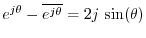 , and
we obtain the following classic identities:
, and
we obtain the following classic identities:

Next Section:
De Moivre's Theorem
Previous Section:
Elementary Relationships