Euler's Identity
Euler's identity (or ``theorem'' or ``formula'') is
 (Euler's Identity)
 ''. (The right-hand side,
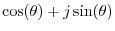 , is assumed to be understood.) Since
  is just a
particular real number, we only really have to explain what we mean by
imaginary exponents. (We'll also see where comes from in the
process.) Imaginary exponents will be obtained as a generalization of
real exponents. Therefore, our first task is to define exactly what
we mean by
is just a
particular real number, we only really have to explain what we mean by
imaginary exponents. (We'll also see where comes from in the
process.) Imaginary exponents will be obtained as a generalization of
real exponents. Therefore, our first task is to define exactly what
we mean by  , where
  is any real number, and
  is any
positive real number.
is any
positive real number.
Next Section:
Positive Integer Exponents
Previous Section:
Complex_Number Problems