FFT of a Simple Sinusoid
Our first example is an FFT of the simple sinusoid

 (frequency
  Hz) and
 (sampling rate
  set to 1). Since we're using a
Cooley-Tukey FFT, the signal length
set to 1). Since we're using a
Cooley-Tukey FFT, the signal length  should be a power of
  for fastest results. Here is the Matlab code:
% Example 1: FFT of a DFT-sinusoid

% Parameters:
N = 64;              % Must be a power of two
T = 1;               % Set sampling rate to 1
A = 1;               % Sinusoidal amplitude
phi = 0;             % Sinusoidal phase
f = 0.25;            % Frequency (cycles/sample)
n = [0:N-1];         % Discrete time axis
x = A*cos(2*pi*n*f*T+phi); % Sampled sinusoid
X = fft(x);          % Spectrum

% Plot time data:
figure(1);
subplot(3,1,1);
plot(n,x,'*k');
ni = [0:.1:N-1];     % Interpolated time axis
hold on;
plot(ni,A*cos(2*pi*ni*f*T+phi),'-k'); grid off;
title('Sinusoid at 1/4 the Sampling Rate');
xlabel('Time (samples)');
ylabel('Amplitude');
text(-8,1,'a)');
hold off;

% Plot spectral magnitude:
magX = abs(X);
fn = [0:1/N:1-1/N];  % Normalized frequency axis
subplot(3,1,2);
stem(fn,magX,'ok'); grid on;
xlabel('Normalized Frequency (cycles per sample))');
ylabel('Magnitude (Linear)');
text(-.11,40,'b)');

% Same thing on a dB scale:
spec = 20*log10(magX); % Spectral magnitude in dB
subplot(3,1,3);
plot(fn,spec,'--ok'); grid on;
axis([0 1 -350 50]);
xlabel('Normalized Frequency (cycles per sample))');
ylabel('Magnitude (dB)');
text(-.11,50,'c)');
cmd = ['print -deps ', '../eps/example1.eps'];
disp(cmd); eval(cmd);
![\includegraphics[width=\twidth]{eps/example1}](http://www.dsprelated.com/josimages_new/mdft/img1494.png) |
 . a) Time waveform. b)
The results are shown in Fig.8.1. The time-domain signal is
shown in the upper plot (Fig.8.1a), both in pseudo-continuous
and sampled form. In the middle plot (Fig.8.1b), we see two
peaks in the magnitude spectrum, each at magnitude  on a linear
scale, located at normalized frequencies
on a linear
scale, located at normalized frequencies  and
and
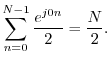
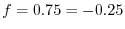 . A spectral peak amplitude of
 is what we
expect, since
is what we
expect, since

 , this reduces to
 and
and
 , this happens at bin numbers
 and
and
 . However, recall that array indexes
in matlab start at
. However, recall that array indexes
in matlab start at  , so that these peaks will really show up at
indexes
, so that these peaks will really show up at
indexes  and
and  in the magX array.
The spectrum should be exactly zero at the other bin numbers. How
accurately this happens can be seen by looking on a dB scale, as shown in
Fig.8.1c. We see that the spectral magnitude in the other bins is
on the order of  dB lower, which is close enough to zero for audio
work
dB lower, which is close enough to zero for audio
work
 .
.
Next Section:
FFT of a Not-So-Simple Sinusoid
Previous Section:
Why a DFT is usually called an FFT in practice