Fourier Series (FS) and Relation to DFT
In continuous time, a periodic signal  , with period
  seconds,B.2 may be expanded
into a Fourier series with coefficients given by
seconds,B.2 may be expanded
into a Fourier series with coefficients given by

where
 is the
  th harmonic frequency
(rad/sec). The generally complex value
th harmonic frequency
(rad/sec). The generally complex value
 is called the
th Fourier series coefficient. The normalization by
is called the
th Fourier series coefficient. The normalization by  is optional, but often included to make the Fourier series
coefficients independent of the fundamental frequency , and
thereby depend only on the shape of one period of the time
waveform.
is optional, but often included to make the Fourier series
coefficients independent of the fundamental frequency , and
thereby depend only on the shape of one period of the time
waveform.
Relation of the DFT to Fourier Series
We now show that the DFT of a sampled signal  (of length
  ),
is proportional to the
Fourier series coefficients of the continuous
periodic signal obtained by
repeating and interpolating
),
is proportional to the
Fourier series coefficients of the continuous
periodic signal obtained by
repeating and interpolating  . More precisely, the DFT of the
samples comprising one period equals times the Fourier series
coefficients. To avoid aliasing upon sampling, the continuous-time
signal must be bandlimited to less than half the sampling
rate (see Appendix D); this implies that at most
complex harmonic components can be nonzero in the original
continuous-time signal.
. More precisely, the DFT of the
samples comprising one period equals times the Fourier series
coefficients. To avoid aliasing upon sampling, the continuous-time
signal must be bandlimited to less than half the sampling
rate (see Appendix D); this implies that at most
complex harmonic components can be nonzero in the original
continuous-time signal.
If is bandlimited to
 , it can be sampled
at intervals of
, it can be sampled
at intervals of  seconds without aliasing (see
§D.2). One way to sample a signal inside an integral
expression such as
Eq.
seconds without aliasing (see
§D.2). One way to sample a signal inside an integral
expression such as
Eq. (B.5) is to multiply it by a continuous-time impulse train
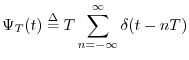
where
 is the continuous-time impulse signal
defined in Eq.(B.3).
is the continuous-time impulse signal
defined in Eq.(B.3).
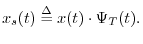
We wish to find the continuous-time Fourier series of the
sampled periodic signal  . Thus, we replace in
Eq.(B.5) by
. Thus, we replace in
Eq.(B.5) by
 (B.4)), the
Fourier series of
(B.4)), the
Fourier series of  isB.3
isB.3

If the sampling interval is chosen so that it divides the signal
period , then the number of samples under the integral is an integer
 , and we obtain
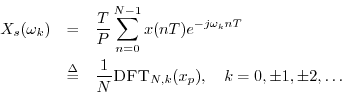
where
![$ x_p\isdef [x(0),x(T),\dots,x((N-1)T)]$](http://www.dsprelated.com/josimages_new/mdft/img1719.png) . Thus,
. Thus,
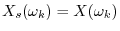 for all at which the bandlimited
periodic signal has a nonzero harmonic. When is odd,
can be nonzero for
for all at which the bandlimited
periodic signal has a nonzero harmonic. When is odd,
can be nonzero for
![$ k\in[-(N-1)/2,(N-1)/2]$](http://www.dsprelated.com/josimages_new/mdft/img1721.png) , while for
even, the maximum nonzero harmonic-number range is
, while for
even, the maximum nonzero harmonic-number range is
![$ k\in[-N/2+1,N/2-1]$](http://www.dsprelated.com/josimages_new/mdft/img1722.png) .
.
In summary,

Next Section:
Differentiation Theorem
Previous Section:
Fourier Transform (FT) and Inverse