How Many Bits are Enough for Digital Audio?
Armed with the above knowledge, we can visit the question ``how many
bits are enough'' for digital audio. Since the threshold of hearing
is around 0 db SPL, the ``threshold of pain'' is around 120 dB SPL,
and each bit in a linear PCM format is worth about
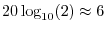 dB of dynamic range, we find that we need
 bits to
represent the full dynamic range of audio in a linear fixed-point
format. This is a simplistic analysis because it is not quite right
to equate the least-significant bit with the threshold of hearing;
instead, we would like to adjust the quantization noise floor
to just below the threshold of hearing. Since the threshold of
hearing is non-uniform, we would also prefer a shaped
quantization noise floor (a feat that can be accomplished using
filtered error feedbackG.3.) Nevertheless, the simplistic result gives an
answer similar to the more careful analysis, and 20 bits is a good number.
However, this still does not provide for
headroom needed in a digital recording scenario. We also need both
headroom and guard bits on the lower end when we plan to carry
out a lot of signal processing operations, especially digital
filtering. As an example, a 1024-point FFT (Fast Fourier Transform)
can give amplitudes 1024 times the input amplitude (such as in the
case of a constant ``dc'' input signal), thus requiring 10 headroom
bits. In general, 24 fixed-point bits are pretty reasonable to work
with, although you still have to scale very carefully, and 32 bits are
preferable.
bits to
represent the full dynamic range of audio in a linear fixed-point
format. This is a simplistic analysis because it is not quite right
to equate the least-significant bit with the threshold of hearing;
instead, we would like to adjust the quantization noise floor
to just below the threshold of hearing. Since the threshold of
hearing is non-uniform, we would also prefer a shaped
quantization noise floor (a feat that can be accomplished using
filtered error feedbackG.3.) Nevertheless, the simplistic result gives an
answer similar to the more careful analysis, and 20 bits is a good number.
However, this still does not provide for
headroom needed in a digital recording scenario. We also need both
headroom and guard bits on the lower end when we plan to carry
out a lot of signal processing operations, especially digital
filtering. As an example, a 1024-point FFT (Fast Fourier Transform)
can give amplitudes 1024 times the input amplitude (such as in the
case of a constant ``dc'' input signal), thus requiring 10 headroom
bits. In general, 24 fixed-point bits are pretty reasonable to work
with, although you still have to scale very carefully, and 32 bits are
preferable.
Next Section:
When Do We Have to Swap Bytes?
Previous Section:
Fractional Binary Fixed-Point Numbers