Informal Derivation of Taylor Series
We have a function  and we want to approximate it using an
 th-order polynomial:

 , the approximation error, is called the
remainder term. We may
assume
, the approximation error, is called the
remainder term. We may
assume  and are real, but the following derivation
generalizes unchanged to the complex case.
and are real, but the following derivation
generalizes unchanged to the complex case.
Our problem is to find fixed constants
 so as to obtain
the best approximation possible. Let's proceed optimistically as though
the approximation will be perfect, and assume
so as to obtain
the best approximation possible. Let's proceed optimistically as though
the approximation will be perfect, and assume
 for all
(
for all
(
 ), given the right values of
  . Then at
  we
must have
we
must have

 to go! Now let's look at the first
derivative of with respect to , again assuming that
:
to go! Now let's look at the first
derivative of with respect to , again assuming that
:
 gives
gives

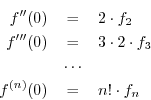
where
 denotes the th derivative of with respect to
, evaluated at . Solving the above relations for the desired
constants yields
denotes the th derivative of with respect to
, evaluated at . Solving the above relations for the desired
constants yields
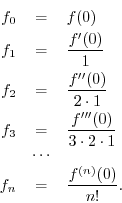
Thus, defining
 (as it always is), we have derived the
following polynomial approximation:
(as it always is), we have derived the
following polynomial approximation:
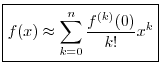 th-order Taylor series expansion of about the
point . Its derivation was quite simple. The hard part is
showing that the approximation error (remainder term
) is
small over a wide interval of values. Another ``math job'' is to
determine the conditions under which the approximation error
approaches zero for all as the order goes to infinity. The
main point to note here is that the Taylor series itself is simple to
derive.
th-order Taylor series expansion of about the
point . Its derivation was quite simple. The hard part is
showing that the approximation error (remainder term
) is
small over a wide interval of values. Another ``math job'' is to
determine the conditions under which the approximation error
approaches zero for all as the order goes to infinity. The
main point to note here is that the Taylor series itself is simple to
derive.
Next Section:
Taylor Series with Remainder
Previous Section:
Appendix: Frequencies Representable by a Geometric Sequence