Matrix Formulation of the DFT
The DFT can be formulated as a complex matrix multiply, as we show in this section. (This section can be omitted without affecting what follows.) For basic definitions regarding matrices, see Appendix H.
The DFT consists of inner products of the input signal
 with sampled complex sinusoidal sections
  :
:

![$\displaystyle \underbrace{
\left[\begin{array}{c}
X(\omega_0) \\
X(\omega_1) ...
...
x(2) \\
\vdots \\
x(N-1)
\end{array}\right]
}_{\displaystyle\underline{x}}
$](http://www.dsprelated.com/josimages_new/mdft/img1089.png)
![$\displaystyle \underline{X}= \mathbf{S}^\ast_N \underline{x}
= \left[\begin{arr...
...\ [2pt] \vdots \\ [2pt] \left<\underline{x},\sv_{N-1}\right>\end{array}\right]
$](http://www.dsprelated.com/josimages_new/mdft/img1090.png)
 denotes the
DFT matrix
denotes the
DFT matrix
![$ \mathbf{S}^\ast_N[k,n]\isdef W_N^{-kn} \isdef
e^{-j2\pi k n/N}$](http://www.dsprelated.com/josimages_new/mdft/img1092.png) , i.e.,
, i.e.,
![\begin{eqnarray*}
\mathbf{S}^\ast_N
&\!\!\isdef \!\!& \left[\begin{array}{cccc}...
...-1)/N} & \cdots & e^{-j 2\pi (N-1)(N-1)/N}
\end{array}\!\right].
\end{eqnarray*}](http://www.dsprelated.com/josimages_new/mdft/img1093.png)
The notation
 denotes the
Hermitian transpose of the complex matrix
denotes the
Hermitian transpose of the complex matrix  (transposition
and complex conjugation).
(transposition
and complex conjugation).
Note that the  th column of
 is the th DFT sinusoid, so
that the th row of the DFT matrix
is the
complex-conjugate of the th DFT sinusoid. Therefore, multiplying
the DFT matrix times a signal vector
produces a column-vector
is the th DFT sinusoid, so
that the th row of the DFT matrix
is the
complex-conjugate of the th DFT sinusoid. Therefore, multiplying
the DFT matrix times a signal vector
produces a column-vector
 in which the th element
![$ \underline{X}[k]$](http://www.dsprelated.com/josimages_new/mdft/img1097.png) is the inner
product of the th DFT sinusoid with
, or
is the inner
product of the th DFT sinusoid with
, or
![$ \underline{X}[k]=\underline{s}^\ast_k\underline{x}
= \left<\underline{x},s_k\right>$](http://www.dsprelated.com/josimages_new/mdft/img1098.png) , as expected.
, as expected.
Computation of the DFT matrix in Matlab is illustrated in §I.4.3.
The inverse DFT matrix is simply
 . That is,
we can perform the inverse DFT operation as
. That is,
we can perform the inverse DFT operation as

Since the forward DFT is
,
substituting
from Eq. (6.2) into the forward DFT
leads quickly to the conclusion that
(6.2) into the forward DFT
leads quickly to the conclusion that
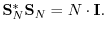
This equation succinctly states that the columns of
are orthogonal, which, of course, we already knew. I.e.,
 for
for  , and
, and
 :
:
![\begin{eqnarray*}
\mathbf{S}^\ast_N \mathbf{S}_N
&\!\!=\!\!&
\left[\!\begin{arr...
...0 & 0 & 0 & \cdots & N
\end{array}\!\right]
= N\cdot \mathbf{I}.
\end{eqnarray*}](http://www.dsprelated.com/josimages_new/mdft/img1105.png)
The normalized DFT matrix is given by
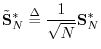
 , so that Eq.(6.3) becomes
 are orthonormal. Such a
complex matrix is said to be unitary.
are orthonormal. Such a
complex matrix is said to be unitary.
When a real matrix
 satisfies
 , then
is said to be
orthogonal.
``Unitary'' is the generalization of ``orthogonal'' to
complex matrices.
, then
is said to be
orthogonal.
``Unitary'' is the generalization of ``orthogonal'' to
complex matrices.
Next Section:
DFT Problems
Previous Section:
The Length 2 DFT