Operator Notation
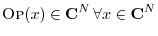
In this book, an operator is defined as a
signal-valued function of a signal. Thus, for the space
of length  complex sequences, an operator
 is a mapping
from
is a mapping
from  to :
to :

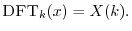
 :7.3
:7.3
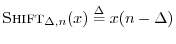
 is obtained from
  by shifting it
  samples.
Note that operator notation is not standard in the field of
digital signal processing. It can be regarded as being influenced by
the field of computer science. In the Fourier theorems below, both
operator and conventional signal-processing notations are provided. In the
author's opinion, operator notation is consistently clearer, allowing
powerful expressions to be written naturally in one line (e.g., see
Eq. (7.8)), and it is much closer to how things look in
a readable computer program (such as in the matlab language).
(7.8)), and it is much closer to how things look in
a readable computer program (such as in the matlab language).
Next Section:
Flip Operator
Previous Section:
Modulo Indexing, Periodic Extension