Projection of Circular Motion
Interpreting the real and imaginary parts of the complex sinusoid,
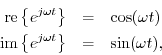
in the complex plane, we see that sinusoidal motion is the
projection of circular motion onto any straight line. Thus, the
sinusoidal motion
 is the projection of the circular
motion
is the projection of the circular
motion
 onto the
  (real-part) axis, while
 is the projection of
onto the
is the projection of
onto the  (imaginary-part) axis.
Figure 4.9 shows a plot of a complex sinusoid versus time, along with its
projections onto coordinate planes. This is a 3D plot showing the
 -plane versus time. The axes are the real part, imaginary part, and
time. (Or we could have used magnitude and phase versus time.)
-plane versus time. The axes are the real part, imaginary part, and
time. (Or we could have used magnitude and phase versus time.)
![\includegraphics[scale=0.8]{eps/circle}](http://www.dsprelated.com/josimages_new/mdft/img464.png)
Note that the left projection (onto the plane) is a circle, the lower
projection (real-part vs. time) is a cosine, and the upper projection
(imaginary-part vs. time) is a sine. A point traversing the plot projects
to uniform circular motion in the plane, and sinusoidal motion on the
two other planes.
Next Section:
Positive and Negative Frequencies
Previous Section:
Circular Motion