Projection onto Linearly Dependent Vectors
Now consider another example:
![\begin{eqnarray*}
\sv_0 &\isdef & [1,1], \\
\sv_1 &\isdef & [-1,-1].
\end{eqnarray*}](http://www.dsprelated.com/josimages_new/mdft/img916.png)
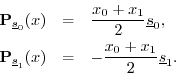
The projections of
![$ x=[x_0,x_1]$](http://www.dsprelated.com/josimages_new/mdft/img917.png) onto these vectors are
onto these vectors are
The sum of the projections is
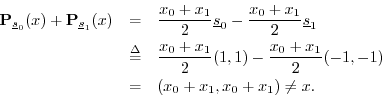
Something went wrong, but what? It turns out that a set of  vectors can be used to reconstruct an arbitrary vector in
  from
its projections only if they are linearly independent. In
general, a set of vectors is linearly independent if none of them can
be expressed as a linear combination of the others in the set. What
this means intuitively is that they must ``point in different
directions'' in -space. In this example
from
its projections only if they are linearly independent. In
general, a set of vectors is linearly independent if none of them can
be expressed as a linear combination of the others in the set. What
this means intuitively is that they must ``point in different
directions'' in -space. In this example
 so that they
lie along the same line in
so that they
lie along the same line in  -space. As a result, they are
linearly dependent: one is a linear combination of the other
(
-space. As a result, they are
linearly dependent: one is a linear combination of the other
(
 ).
).
Next Section:
Projection onto Non-Orthogonal Vectors
Previous Section:
Changing Coordinates