Projection onto Non-Orthogonal Vectors
Consider this example:
![\begin{eqnarray*}
\sv_0 &\isdef & [1,1] \\
\sv_1 &\isdef & [0,1]
\end{eqnarray*}](http://www.dsprelated.com/josimages_new/mdft/img922.png)
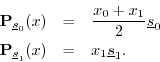
These point in different directions, but they are not orthogonal. What happens now? The projections are
The sum of the projections is
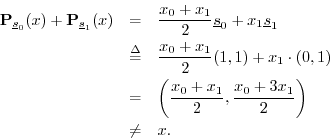
So, even though the vectors are linearly independent, the sum of
projections onto them does not reconstruct the original vector. Since the
sum of projections worked in the orthogonal case, and since orthogonality
implies linear independence, we might conjecture at this point that the sum
of projections onto a set of  vectors will reconstruct the original
vector only when the vector set is orthogonal, and this is true,
as we will show.
vectors will reconstruct the original
vector only when the vector set is orthogonal, and this is true,
as we will show.
It turns out that one can apply an orthogonalizing process, called
Gram-Schmidt orthogonalization to any linearly independent
vectors in  so as to form an orthogonal set which will always
work. This will be derived in Section 5.10.4.
so as to form an orthogonal set which will always
work. This will be derived in Section 5.10.4.
Obviously, there must be at least vectors in the set. Otherwise,
there would be too few degrees of freedom to represent an
arbitrary
 . That is, given the coordinates
 of
of  (which are scale factors relative to
the coordinate vectors
(which are scale factors relative to
the coordinate vectors
 in ), we have to find at least
coefficients of projection (which we may think of as coordinates
relative to new coordinate vectors
in ), we have to find at least
coefficients of projection (which we may think of as coordinates
relative to new coordinate vectors  ). If we compute only
  coefficients, then we would be mapping a set of complex numbers to
numbers. Such a mapping cannot be invertible in general. It
also turns out linearly independent vectors is always sufficient.
The next section will summarize the general results along these lines.
coefficients, then we would be mapping a set of complex numbers to
numbers. Such a mapping cannot be invertible in general. It
also turns out linearly independent vectors is always sufficient.
The next section will summarize the general results along these lines.
Next Section:
General Conditions
Previous Section:
Projection onto Linearly Dependent Vectors