Radix 2 FFT Complexity is N Log N
Putting together the length  DFT from the
  length-
 DFTs in
a radix-2 FFT, the only multiplies needed are those used to combine
two small DFTs to make a DFT twice as long, as in Eq.
DFTs in
a radix-2 FFT, the only multiplies needed are those used to combine
two small DFTs to make a DFT twice as long, as in Eq. (A.1).
Since there are approximately (complex) multiplies needed for each
stage of the DIT decomposition, and only
(A.1).
Since there are approximately (complex) multiplies needed for each
stage of the DIT decomposition, and only  stages of DIT (where
denotes the log-base-2 of ), we see that the total number
of multiplies for a length DFT is reduced from
stages of DIT (where
denotes the log-base-2 of ), we see that the total number
of multiplies for a length DFT is reduced from
 to
to
 , where
 means ``on the order of
  ''. More
precisely, a complexity of
means that given any
implementation of a length- radix-2 FFT, there exist a constant
''. More
precisely, a complexity of
means that given any
implementation of a length- radix-2 FFT, there exist a constant  and integer
  such that the computational complexity
 satisfies
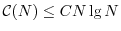
 . In summary, the complexity of the radix-2 FFT is said
to be ``N log N'', or
.
. In summary, the complexity of the radix-2 FFT is said
to be ``N log N'', or
.
Next Section:
DBm Scale
Previous Section:
Spectral Phase