Relation to Stretch Theorem
It is instructive to interpret the periodic interpolation theorem in
terms of the stretch theorem,
 .
To do this, it is convenient to define a ``zero-centered rectangular
window'' operator:
.
To do this, it is convenient to define a ``zero-centered rectangular
window'' operator:
Definition: For any
 and any odd integer
  we define the
length
we define the
length  even rectangular windowing operation by

 , sets the spectrum to zero everywhere outside a
zero-centered interval of samples. Note that
, sets the spectrum to zero everywhere outside a
zero-centered interval of samples. Note that
 is
the
ideal lowpass filtering operation in the frequency domain.
The ``cut-off frequency'' is
is
the
ideal lowpass filtering operation in the frequency domain.
The ``cut-off frequency'' is
![$ \omega_c = 2\pi[(M-1)/2]/N$](http://www.dsprelated.com/josimages_new/mdft/img1463.png) radians per
sample.
For even , we allow
radians per
sample.
For even , we allow  to be ``passed'' by the window,
but in our usage (below), this sample should always be zero anyway.
With this notation defined we can efficiently restate
periodic interpolation in terms of the
to be ``passed'' by the window,
but in our usage (below), this sample should always be zero anyway.
With this notation defined we can efficiently restate
periodic interpolation in terms of the
 operator:
Theorem: When
 consists of one or more periods from a periodic
signal
consists of one or more periods from a periodic
signal
 ,
,

 by
the integer factor
by
the integer factor  may be carried out by first stretching by
the factor (inserting
may be carried out by first stretching by
the factor (inserting  zeros between adjacent samples of
), taking the DFT, applying the ideal lowpass filter as an
zeros between adjacent samples of
), taking the DFT, applying the ideal lowpass filter as an
 -point rectangular window in the frequency domain, and performing
the inverse DFT.
-point rectangular window in the frequency domain, and performing
the inverse DFT.
Proof: First, recall that
 . That is,
stretching a signal by the factor gives a new signal
. That is,
stretching a signal by the factor gives a new signal
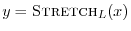 which has a spectrum
  consisting of copies of
repeated around the unit circle. The ``baseband copy'' of in
can be defined as the -sample sequence centered about frequency
zero. Therefore, we can use an ``ideal filter'' to ``pass'' the
baseband spectral copy and zero out all others, thereby converting
consisting of copies of
repeated around the unit circle. The ``baseband copy'' of in
can be defined as the -sample sequence centered about frequency
zero. Therefore, we can use an ``ideal filter'' to ``pass'' the
baseband spectral copy and zero out all others, thereby converting
 to
to
 . I.e.,

Next Section:
Bandlimited Interpolation of Time-Limited Signals
Previous Section:
Illustration of the Downsampling/Aliasing Theorem in Matlab