Round-Off Error Variance
This appendix shows how to derive that the noise power of amplitude
quantization error is  , where
  is the quantization step
size. This is an example of a topic in statistical signal
processing, which is beyond the scope of this book. (Some good
textbooks in this area include
[27,51,34,33,65,32].)
However, since the main result is so useful in practice, it is derived
below anyway, with needed definitions given along the way. The
interested reader is encouraged to explore one or more of the
above-cited references in statistical signal processing.G.10
is the quantization step
size. This is an example of a topic in statistical signal
processing, which is beyond the scope of this book. (Some good
textbooks in this area include
[27,51,34,33,65,32].)
However, since the main result is so useful in practice, it is derived
below anyway, with needed definitions given along the way. The
interested reader is encouraged to explore one or more of the
above-cited references in statistical signal processing.G.10
Each round-off error in quantization noise  is modeled as a
uniform random variable between
is modeled as a
uniform random variable between  and
and  . It therefore
has the following probability density function (pdf) [51]:G.11
. It therefore
has the following probability density function (pdf) [51]:G.11
![$\displaystyle p_e(x) = \left\{\begin{array}{ll}
\frac{1}{q}, & \left\vert x\ri...
...2} \\ [5pt]
0, & \left\vert x\right\vert>\frac{q}{2} \\
\end{array} \right.
$](http://www.dsprelated.com/josimages_new/mdft/img2027.png) lies in the
interval
lies in the
interval ![$ [x_1,x_2]$](http://www.dsprelated.com/josimages_new/mdft/img2028.png) is given by
is given by
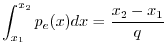
 and
and  lie in the allowed range
![$ [-q/2,
q/2]$](http://www.dsprelated.com/josimages_new/mdft/img2032.png) . We might loosely refer to
. We might loosely refer to  as a probability
distribution, but technically it is a probability density function,
and to obtain probabilities, we have to integrate over one or more
intervals, as above. We use probability distributions for variables
which take on discrete values (such as dice), and we use probability
densities for variables which take on continuous values (such
as round-off errors).
as a probability
distribution, but technically it is a probability density function,
and to obtain probabilities, we have to integrate over one or more
intervals, as above. We use probability distributions for variables
which take on discrete values (such as dice), and we use probability
densities for variables which take on continuous values (such
as round-off errors).
The mean of a random variable is defined as
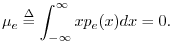
The mean of a signal is the same thing as the
expected value of , which we write as
 .
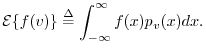
In general, the expected value of any function
.
In general, the expected value of any function  of a
random variable
of a
random variable  is given by
Since the quantization-noise signal is modeled as a series of
independent, identically distributed (iid) random variables, we can
estimate the mean by averaging the signal over time.
Such an estimate is called a sample mean.
Probability distributions are often characterized by their
moments.
The  th moment of the pdf
  is defined as
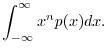
 is the first moment of the
pdf. The second moment is simply the expected value of the random variable
squared, i.e.,
is the first moment of the
pdf. The second moment is simply the expected value of the random variable
squared, i.e.,
 .
.
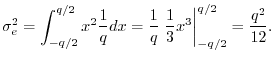
The
variance
of a random variable is defined as
the
second central moment of the pdf:
![$\displaystyle \sigma_e^2 \isdef {\cal E}\{[e(n)-\mu_e]^2\}
= \int_{-\infty}^{\infty} (x-\mu_e)^2 p_e(x) dx
$](http://www.dsprelated.com/josimages_new/mdft/img2042.png)
 instead of . In
the case of round-off errors, the mean is zero, so subtracting out the mean
has no effect. Plugging in the constant pdf for our random variable
which we assume is uniformly distributed on
, we obtain the
variance
instead of . In
the case of round-off errors, the mean is zero, so subtracting out the mean
has no effect. Plugging in the constant pdf for our random variable
which we assume is uniformly distributed on
, we obtain the
variance
 can be estimated by averaging
  over time, that is, by computing the mean square. Such an estimate
is called the sample variance. For sampled physical processes, the
sample variance is proportional to the average power in the signal.
Finally, the square root of the sample variance (the rms level) is
sometimes called the standard deviation of the signal, but this term
is only precise when the random variable has a Gaussian pdf.
over time, that is, by computing the mean square. Such an estimate
is called the sample variance. For sampled physical processes, the
sample variance is proportional to the average power in the signal.
Finally, the square root of the sample variance (the rms level) is
sometimes called the standard deviation of the signal, but this term
is only precise when the random variable has a Gaussian pdf.
Next Section:
Matrix Multiplication
Previous Section:
Logarithmic Number Systems for Audio