Acoustic Energy Density
The two forms of energy in a wave are kinetic and
potential. Denoting them at a particular time  and position
 by
by
 and
and
 , respectively, we can write them in
terms of velocity
, respectively, we can write them in
terms of velocity  and wave impedance
  as follows:
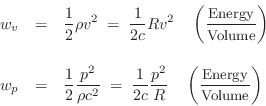
More specifically,  and
and  may be called the acoustic kinetic
energy density and the acoustic potential energy density, respectively.
may be called the acoustic kinetic
energy density and the acoustic potential energy density, respectively.
At each point in a plane wave, we have
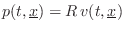 (pressure equals wave-impedance times velocity), and so
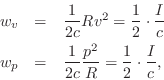
where
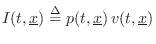 denotes the acoustic
intensity (pressure times velocity) at time and position
.
Thus, half of the acoustic intensity
denotes the acoustic
intensity (pressure times velocity) at time and position
.
Thus, half of the acoustic intensity  in a plane wave is kinetic,
and the other half is potential:B.30
in a plane wave is kinetic,
and the other half is potential:B.30
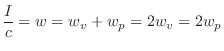 has units of energy per unit
area per unit time while the acoustic energy density
has units of energy per unit
area per unit time while the acoustic energy density  has
units of energy per unit volume.
has
units of energy per unit volume.
Next Section:
Energy Decay through Lossy Boundaries
Previous Section:
Acoustic Intensity