







Allpass from Two Combs
An allpass filter can be defined as any filter having a gain of
 at all frequencies (but typically different delays at different
frequencies).
at all frequencies (but typically different delays at different
frequencies).
It is well known that the series combination of a feedforward and feedback comb filter (having equal delays) creates an allpass filter when the feedforward coefficient is the negative of the feedback coefficient.
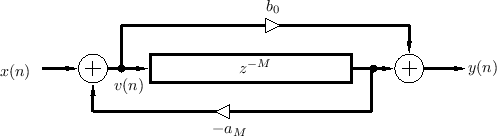
Figure 2.30 shows a combination feedforward/feedback comb filter structure which shares the same delay line.3.13 By inspection of Fig.2.30, the difference equation is
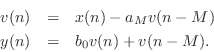
This can be recognized as a digital filter in direct form II
[449]. Thus, the system of Fig.2.30 can be interpreted as
the series combination of a feedback comb filter (Fig.2.24) taking
 to
to  followed by a feedforward comb filter (Fig.2.23)
taking to
followed by a feedforward comb filter (Fig.2.23)
taking to  . By the commutativity of LTI systems, we can
interchange the order to get
. By the commutativity of LTI systems, we can
interchange the order to get
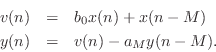
Substituting the right-hand side of the first equation above for
in the second equation yields more simply

This can be recognized as direct form I [449], which requires
 delays instead of
  ; however, unlike direct-form II,
direct-form I cannot suffer from ``internal'' overflow--overflow can
happen only at the output.
; however, unlike direct-form II,
direct-form I cannot suffer from ``internal'' overflow--overflow can
happen only at the output.
The coefficient symbols  and
and  here have been chosen to
correspond to standard notation for the transfer function
here have been chosen to
correspond to standard notation for the transfer function

 ,
where
,
where  denotes radian frequency and
  denotes the sampling
period in seconds [449]. For an allpass filter, the frequency
magnitude must be the same for all
denotes the sampling
period in seconds [449]. For an allpass filter, the frequency
magnitude must be the same for all
![$ \omega\in[-\pi/T,\pi/T]$](http://www.dsprelated.com/josimages_new/pasp/img596.png) .
.
An allpass filter is obtained when
 , or, in the case
of real coefficients, when
, or, in the case
of real coefficients, when  . To see this, let
 . Then we have

Next Section:
Nested Allpass Filters
Previous Section:
FDN Stability












