Angular Velocity Vector
When working with rotations, it is convenient to define the
angular-velocity vector as a vector
 pointing
along the axis of rotation. There are two directions we could
choose from, so we pick the one corresponding to the right-hand
rule, i.e., when the fingers of the right hand curl in the direction
of the rotation, the thumb points in the direction of the angular
velocity vector.B.18 The
length
pointing
along the axis of rotation. There are two directions we could
choose from, so we pick the one corresponding to the right-hand
rule, i.e., when the fingers of the right hand curl in the direction
of the rotation, the thumb points in the direction of the angular
velocity vector.B.18 The
length
 should obviously equal the angular
velocity
should obviously equal the angular
velocity  . It is convenient also to work with a unit-length
variant
. It is convenient also to work with a unit-length
variant
 .
.
As introduced in Eq. (B.8) above, the mass moment of inertia is
given by
(B.8) above, the mass moment of inertia is
given by  where
where  is the distance from the (instantaneous)
axis of rotation to the mass
is the distance from the (instantaneous)
axis of rotation to the mass  located at
 . In
terms of the angular-velocity vector
. In
terms of the angular-velocity vector
 , we can write this as
(see Fig.B.6)
, we can write this as
(see Fig.B.6)


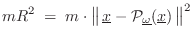
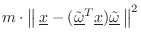
where

 onto
(or
onto
(or
 )
[451]. Thus, we can project the mass position
onto the
angular-velocity vector
and subtract to get the component of
that is orthogonal to
, and the length of that difference
vector is the distance to the rotation axis , as shown in
Fig.B.6.
)
[451]. Thus, we can project the mass position
onto the
angular-velocity vector
and subtract to get the component of
that is orthogonal to
, and the length of that difference
vector is the distance to the rotation axis , as shown in
Fig.B.6.
![\includegraphics[width=1.5in]{eps/pxov}](http://www.dsprelated.com/josimages_new/pasp/img2806.png) |
 onto the angular
velocity vector
onto the angular
velocity vector
Using the vector cross product (defined in the next section),
we will show (in §B.4.17) that can be written more succinctly as

Next Section:
Vector Cross Product
Previous Section:
Two Masses Connected by a Rod