







Applying Newton's Laws of Motion
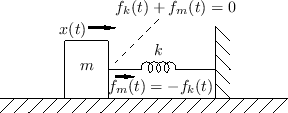
As a simple example, consider a mass  driven along a frictionless
surface by an ideal spring
driven along a frictionless
surface by an ideal spring  , as shown in Fig.B.2.
Assume that the mass position
, as shown in Fig.B.2.
Assume that the mass position  corresponds to the spring at rest,
i.e., not stretched or compressed. The force necessary to compress the
spring by a distance
corresponds to the spring at rest,
i.e., not stretched or compressed. The force necessary to compress the
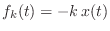
spring by a distance  is given by Hooke's law (§B.1.3):
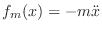 of
the mass , i.e.
of
the mass , i.e.  ,
yieldingB.6
,
yieldingB.6

where we have defined
 as the initial displacement of the mass
along . This is a differential equation whose solution
gives the equation of motion of the mass-spring junction for all
time:B.7
as the initial displacement of the mass
along . This is a differential equation whose solution
gives the equation of motion of the mass-spring junction for all
time:B.7

where
 denotes the frequency of
oscillation in radians per second. More generally, the complete
space of solutions to Eq.
denotes the frequency of
oscillation in radians per second. More generally, the complete
space of solutions to Eq. (B.4), corresponding to all possible
initial displacements
(B.4), corresponding to all possible
initial displacements  and initial velocities
 , is the
set of all sinusoidal oscillations at frequency
, is the
set of all sinusoidal oscillations at frequency  :
:
 and phase offset
  are
determined by the initial conditions, i.e., the initial position
and initial velocity
of the mass (its initial
state) when we ``let it go'' or ``push it off'' at time
are
determined by the initial conditions, i.e., the initial position
and initial velocity
of the mass (its initial
state) when we ``let it go'' or ``push it off'' at time  .
.
Next Section:
Potential Energy in a Spring
Previous Section:
Hooke's Law












