







Arctangent Series Expansion
For example, the arctangent function used above can be expanded as
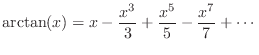
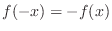 . For
any smooth function, the odd-order terms of its Taylor expansion
comprise the odd part of the function, while the even-order terms
comprise the even part. The original function is clearly given
by the sum of its odd and even parts.7.17
. For
any smooth function, the odd-order terms of its Taylor expansion
comprise the odd part of the function, while the even-order terms
comprise the even part. The original function is clearly given
by the sum of its odd and even parts.7.17
The clipping nonlinearity in Eq. (6.17) is not so amenable to a
series expansion. In fact, it is its own series expansion! Since it
is not differentiable at
(6.17) is not so amenable to a
series expansion. In fact, it is its own series expansion! Since it
is not differentiable at  , it must be represented as three
separate series over the intervals
, it must be represented as three
separate series over the intervals
![$ (-\infty,1]$](http://www.dsprelated.com/josimages_new/pasp/img1531.png) ,
, ![$ [-1,1]$](http://www.dsprelated.com/josimages_new/pasp/img1532.png) , and
, and
 , and the result obtained over these intervals is precisely
the definition of
, and the result obtained over these intervals is precisely
the definition of  in Eq.(6.17).
Next Section:
Spectrum of a Memoryless Nonlinearities
Previous Section:
Series Expansions












