Boundary Conditions as Perturbations
To study the effect of boundary conditions on the state transition
matrices
 and
and
 , it is convenient to write the terminated
transition matrix as the sum of of the ``left-clamped'' case
, it is convenient to write the terminated
transition matrix as the sum of of the ``left-clamped'' case

 (for which
  ) plus a series of one or more rank-one
perturbations. For example, introducing a right termination with
reflectance
) plus a series of one or more rank-one
perturbations. For example, introducing a right termination with
reflectance  can be written


where
 is the
  matrix containing a 1 in its
 th entry, and zero elsewhere. (Following established
convention, rows and columns in matrices are numbered from 1.)
th entry, and zero elsewhere. (Following established
convention, rows and columns in matrices are numbered from 1.)
In general, when  is odd, adding
to
corresponds to a connection from left-going waves to
right-going waves, or vice versa (see Fig.E.2). When
is odd, adding
to
corresponds to a connection from left-going waves to
right-going waves, or vice versa (see Fig.E.2). When  is
odd and
is
odd and  is even, the connection flows from the right-going to the
left-going signal path, thus providing a termination (or partial
termination) on the right. Left terminations flow from the bottom to
the top rail in Fig.E.2, and in such connections is even
and is odd. The spatial sample numbers involved in the connection
are
is even, the connection flows from the right-going to the
left-going signal path, thus providing a termination (or partial
termination) on the right. Left terminations flow from the bottom to
the top rail in Fig.E.2, and in such connections is even
and is odd. The spatial sample numbers involved in the connection
are
 and
and
 , where
 denotes the greatest integer less than or equal to
 .
.
The rank-one perturbation of the DW transition matrix Eq. (E.39)
corresponds to the following rank-one perturbation of the FDTD
transition matrix
(E.39)
corresponds to the following rank-one perturbation of the FDTD
transition matrix
 :
:


![\begin{displaymath}\mathbf{T}{\bm \delta}_{8,7}\mathbf{T}^{-1}
=
\left[\!
\begin...
...
0 & 0 & 0 & 0 & 0 & 0 & 1 & -1
\end{array}\!\right].
\protect\end{displaymath}](http://www.dsprelated.com/josimages_new/pasp/img4713.png)
In general, we have
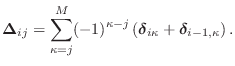
Thus, the general rule is that
transforms to a matrix
 which is zero in all but two rows (or all but one row when
 ). The nonzero rows are numbered and
  (or just when
), and they are identical, being zero in columns
(or just when
), and they are identical, being zero in columns  , and
containing
, and
containing
![$ [1,-1,1,-1,\ldots]$](http://www.dsprelated.com/josimages_new/pasp/img4718.png) starting in column .
starting in column .
Next Section:
Reactive Terminations
Previous Section:
Resistive Terminations