







Brasses
Brass instruments include the trumpet, trombone, French horn, tuba, and other instruments consisting of a horn driven by lip vibrations at one end. The mouthpiece of a brass instrument is generally cup-shaped, and the lips vibrate at a frequency near that of the sounding note.
There are three main components needed in synthesis models for brass instruments: the mouthpiece, bore, and bell. Both cylindrical and conical bores are accurately modeled using digital waveguide techniques, as discussed in previous chapters (see §C.18 for further discussion). However, bore models may need to simulate nonlinear shock wave formation at high dynamic levels [198,341], which is relatively expensive to do [536]. The bell, which flares more rapidly than conical (typically exponentially10.21) does not support true traveling waves [357], and so it must be modeled using a more general simulation technique, such as by means of reflection and transmission filters (discussed in §9.7.2 below).
Modeling the Lips and Mouthpiece
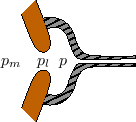
Figure 9.58 depicts a schematic of a brass-player's lips
positioned within a mouthpiece. The air pressure10.22 is denoted  inside the mouth,
  between the lips, and
 within the mouthpiece cup.
A simple first approximation is to assume that the air flow through the lips is inviscid (``frictionless'') and incompressible. In this case, the pressure between the lips is governed by Bernoulli's equation (see §B.7.4):
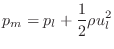
 is the air density (mass per unit volume) and
  denotes the particle velocity (see §B.7.1)
(distance per unit time) between the lips. The particle velocity
denotes the particle velocity (see §B.7.1)
(distance per unit time) between the lips. The particle velocity
 in the mouth is so small that it is usually neglected
(approximated by zero).
in the mouth is so small that it is usually neglected
(approximated by zero).
Following Cullen et al. [98] and previous researchers
[159,161],
one may assume that the flow between the lips creates a jet in the
mouthpiece having velocity . The pressure within the jet is
therefore , the same as between the lips. The jet is assumed to
mix turbulently with the air in the mouthpiece so that it dissipates
its energy without raising pressure in the mouthpiece.10.23
One- and two-mass models were also developed by Rodet and Vergez [388,533]. An early one-mass, ``swinging door'' model that works surprisingly well is in Cook's HosePlayer [89] and and TBone [88]. It is also used in the Brass.cpp patch in the Synthesis Tool Kit [91]; in this simplified model, the lip-valve is modeled as a second-order resonator whose output is squared and hard-clipped to a maximum magnitude.
The acoustic tube in a horn can be modeled as a simple digital waveguide [22,37,436,506,528], whether it is cylindrical or conical. More complicated, flaring horn sections may be modeled as two-port digital filters which provide the appropriate reflection and transmission from the bell [39,50,71,118,406,528]. Section 9.7.2 below summarizes a particularly economical approach to brass bell modeling.
It is known that nonlinear shock waves occur in the bore for large amplitude vibrations [198,341]. A simple nonlinear waveguide simulation of this effect can be implemented by shortening the delay elements slightly when the instantaneous amplitude is large. (The first-order effect of air nonlinearity in large-amplitude wave propagation is an increase in sound speed at very high pressures [52].)
It is also known that the bores of ``bent horns,'' such as the trumpet, do not behave as ideal waveguides [425]. This is because sharp bends in the metal tube cause some scattering, and mode conversion at high frequencies. Such points along the horn can be modeled using high-frequency loss and reflection.
Bell Models
The flaring bell of a horn cannot be accurately modeled as a sparse digital waveguide, because traveling pressure waves only propagate without reflection in conical bores (which include cylindrical bores as a special case) [357].10.24 Digital waveguides are ``sparse'' (free of internal scattering) only when there are long sections at a constant wave impedance.
The most cost-effective bell filters (and, more generally, ``flare filters'') to date appears to be the use of truncated IIR (TIIR) digital filters [540]. These filters use an unstable pole to produce exponentially rising components in the impulse response, but the response is cut off after a finite time, as is needed in the case of a bell impulse response. By fitting a piecewise polynomial/exponential approximation to the reflection impulse response of the trumpet bell, very good approximations can be had for the computational equivalent of approximately a 10th order IIR filter (but using more memory in the form of a delay line, which costs very little computation).
In more detail, the most efficient computational model for flaring bells in brass instruments seems to be one that consists of one or more sections having an impulse response given by the sum of a growing exponential and a constant, i.e.,
![$\displaystyle y(n) = \left\{\begin{array}{ll}
a e^{c n} + b, & n=0,1,2,\ldots,N-1 \\ [5pt]
0, & \mbox{otherwise}. \\
\end{array}\right.
$](http://www.dsprelated.com/josimages_new/pasp/img2591.png)
 can also be generated using a one-pole TIIR
filter, with its pole set to
can also be generated using a one-pole TIIR
filter, with its pole set to  . The remaining reflection impulse
response has a decaying trend, and can therefore be modeled accurately
using one of many conventional filter design techniques. In
[528,529], the Steiglitz-McBride IIR
filter design algorithm [287] yielded good
results from pulse-reflectometry data [425], as shown in
Fig.9.60.
. The remaining reflection impulse
response has a decaying trend, and can therefore be modeled accurately
using one of many conventional filter design techniques. In
[528,529], the Steiglitz-McBride IIR
filter design algorithm [287] yielded good
results from pulse-reflectometry data [425], as shown in
Fig.9.60.
![\includegraphics[width=\twidth]{eps/tiir1simp}](http://www.dsprelated.com/josimages_new/pasp/img2592.png) |
![\includegraphics[width=\twidth]{eps/fig_tot}](http://www.dsprelated.com/josimages_new/pasp/img2593.png) |
The C++ class in the Synthesis Tool Kit (STK) implementing a basic brass synthesis model is called Brass.cpp.
Literature Relevant to Brasses
A nice summary of the musical acoustics of brass instruments is given by Campbell [70].
Research by Cullen et al. [98] and Gilbert et al. [159,161] has been concerned with artificial mouth experiments to verify a theoretical model of vibrating lips, and to calibrate the model to realistic playing conditions. These data can be used in the construction of improved lip-valve models for virtual brass instruments. Additional literature relevant to brass instruments includes [187,186,188,247,529,319,331,336,534,535,536,445,93].
Next Section:
Other Instruments
Previous Section:
Bowed Strings












