







Consistency
A finite-difference scheme is said to be
consistent with the original
partial differential equation if, given any sufficiently
differentiable function  , the differential equation operating
on approaches the value of the finite difference equation
operating on
, the differential equation operating
on approaches the value of the finite difference equation
operating on  , as
, as  and
and  approach zero.
Thus, in the ideal string example, to show the consistency of Eq. (D.3)
we must show that
(D.3)
we must show that
![$\displaystyle \left(\frac{\partial^2}{\partial x^2}
- \frac{1}{c^2}
\frac{\par...
...eft[
(\delta_x + \delta_x^{-1})
-
(\delta_t + \delta_t^{-1})
\right] y_{n,m}
$](http://www.dsprelated.com/josimages_new/pasp/img4454.png) which are second-order differentiable with respect to
which are second-order differentiable with respect to
 and
and  . On the right-hand side, we have introduced the following
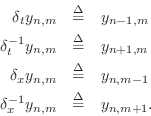
shift operator notation:
. On the right-hand side, we have introduced the following
shift operator notation:


In particular, we have
In taking the limit as and approach zero, we must maintain
the relationship  , and we must scale the FDS by
  in
order to achieve an exact result:
in
order to achieve an exact result:
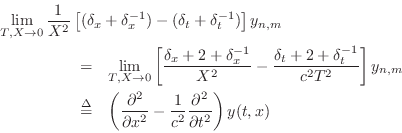
as required. Thus, the FDS is consistent. See, e.g., [481] for more examples.
In summary, consistency of a finite-difference scheme means that, in the limit as the sampling intervals approach zero, the original PDE is obtained from the FDS.
Next Section:
Well Posed Initial-Value Problem
Previous Section:
Cylinder with Conical Cap












