Converting Propagation Distance to Delay Length
We may regard the delay-line memory itself as the fixed ``air'' which
propagates sound samples at a fixed speed  (
( meters per
second at
meters per
second at  degrees Celsius and 1 atmosphere). The input signal
 can be associated with a sound source, and the output signal
 (see Fig.2.1 on page
 ![[*]](../icons/crossref.png) ) can be associated with
the listening point. If the listening point is
) can be associated with
the listening point. If the listening point is  meters away from
the source, then the delay line length
meters away from
the source, then the delay line length  needs to be
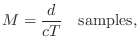
 denotes the discrete-time sampling interval. In other
words, the number of samples delay is the propagation distance
divided by
denotes the discrete-time sampling interval. In other
words, the number of samples delay is the propagation distance
divided by  , the distance sound propagates in one sampling
interval. In practice, rounding
, the distance sound propagates in one sampling
interval. In practice, rounding  to the nearest integer
causes no audible difference, unless the echo time is so short that
the system is not really perceived as an echo (we'll learn about
``comb filters'' in §2.6 below).
to the nearest integer
causes no audible difference, unless the echo time is so short that
the system is not really perceived as an echo (we'll learn about
``comb filters'' in §2.6 below).
Next Section:
Spherical Waves from a Point Source
Previous Section:
Dispersive Traveling Waves