







DW Non-Displacement Inputs
Since a displacement input at position  corresponds to
symmetrically exciting the right- and left-going traveling-wave
components
corresponds to
symmetrically exciting the right- and left-going traveling-wave
components  and
and  , it is of interest to understand what
it means to excite these components antisymmetrically. As
discussed in §E.3.3, an antisymmetric excitation of
traveling-wave components can be interpreted as a velocity
excitation. It was noted that localized velocity excitations in the
FDTD generally correspond to non-localized velocity excitations in the
DW, and that velocity in the DW is proportional to the spatial
derivative of the difference between the left-going and right-going
traveling displacement-wave components (see Eq.
, it is of interest to understand what
it means to excite these components antisymmetrically. As
discussed in §E.3.3, an antisymmetric excitation of
traveling-wave components can be interpreted as a velocity
excitation. It was noted that localized velocity excitations in the
FDTD generally correspond to non-localized velocity excitations in the
DW, and that velocity in the DW is proportional to the spatial
derivative of the difference between the left-going and right-going
traveling displacement-wave components (see Eq. (E.13)). More
generally, the antisymmetric component of displacement-wave excitation
can be expressed in terms of any wave variable which is linearly
independent relative to displacement, such as acceleration, slope,
force, momentum, and so on. Since the state space of a vibrating
string (and other mechanical systems) is traditionally taken to be
position and velocity, it is perhaps most natural to relate the
antisymmetric excitation component to velocity.
(E.13)). More
generally, the antisymmetric component of displacement-wave excitation
can be expressed in terms of any wave variable which is linearly
independent relative to displacement, such as acceleration, slope,
force, momentum, and so on. Since the state space of a vibrating
string (and other mechanical systems) is traditionally taken to be
position and velocity, it is perhaps most natural to relate the
antisymmetric excitation component to velocity.
In practice, the simplest way to handle a velocity input  in a
DW simulation is to first pass it through a first-order integrator of the
form
in a
DW simulation is to first pass it through a first-order integrator of the
form

to convert it to a displacement input. By the equivalence of the DW and FDTD models, this works equally well for the FDTD model. However, in view of §E.3.3, this approach does not take full advantage of the ability of the FDTD scheme to provide localized velocity inputs for applications such as simulating a piano hammer strike. The FDTD provides such velocity inputs for ``free'' while the DW requires the external integrator Eq.
(E.37).
Note, by the way, that these ``integrals'' (both that done internally
by the FDTD and that done by Eq.(E.37)) are merely sums over
discrete time--not true integrals. As a result, they are exact only
at dc (and also trivially at  , where the output amplitude is
zero). Discrete sums can also be considered exact integrators for
impulse-train inputs--a point of view sometimes useful when
interpreting simulation results. For normal bandlimited signals,
discrete sums most accurately approximate integrals in a neighborhood
of dc. The KW-converter filter
, where the output amplitude is
zero). Discrete sums can also be considered exact integrators for
impulse-train inputs--a point of view sometimes useful when
interpreting simulation results. For normal bandlimited signals,
discrete sums most accurately approximate integrals in a neighborhood
of dc. The KW-converter filter
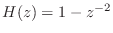 has analogous
properties.
has analogous
properties.
Next Section:
Input Locality
Previous Section:
DW Displacement Inputs












