DW State Space Model
As discussed in §E.2, the traveling-wave decomposition
Eq. (E.4) defines a linear transformation Eq.(E.10) from the DW
state to the FDTD state:
(E.4) defines a linear transformation Eq.(E.10) from the DW
state to the FDTD state:

Since
 is invertible, it qualifies as a linear transformation
for performing a change of coordinates for the state space.
Substituting Eq.(E.27) into the FDTD
state space model Eq.(E.24) gives
is invertible, it qualifies as a linear transformation
for performing a change of coordinates for the state space.
Substituting Eq.(E.27) into the FDTD
state space model Eq.(E.24) gives



Multiplying through Eq.
(E.28) by
 gives a new state-space
representation of the same dynamic system
which we will show is in fact the DW model of Fig.E.2:
gives a new state-space
representation of the same dynamic system
which we will show is in fact the DW model of Fig.E.2:
 |
 |
 |
|
 |
|
 |
(E.30) |
where


To verify that the DW model derived in this manner is the computation diagrammed in Fig.E.2, we may write down the state transition matrix for one subgrid from the figure to obtain the permutation matrix
 ,
,
![$\displaystyle \underbrace{\left[\! \begin{array}{l} \qquad\vdots \\ y^{+}_{n+2,...
...{-}_{n,m+4} \\ \quad\vdots \end{array} \!\right]}_{\underline{x}_W(n)} \protect$](http://www.dsprelated.com/josimages_new/pasp/img4642.png)
and displacement output matrix
 :
:
![\begin{displaymath}
\underbrace{\left[\!
\begin{array}{c}
\vdots \\
y_{n,m-2} \...
...+4} \\
\quad\vdots
\end{array}\!\right]}_{\underline{x}_W(n)}
\end{displaymath}](http://www.dsprelated.com/josimages_new/pasp/img4644.png)
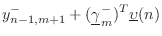
DW Displacement Inputs
We define general DW inputs as follows:
 |
|
 |
(E.33) |
 |
|
 |
(E.34) |
The
 th
th  block of the input matrix
 driving state
components
driving state
components
![$ [y^{+}_{n+2,m},y^{-}_{n+2,m}]^T$](http://www.dsprelated.com/josimages_new/pasp/img4651.png) and multiplying
and multiplying
![$ [\underline{\upsilon}(n+2)^T,\underline{\upsilon}(n+1)^T]^T$](http://www.dsprelated.com/josimages_new/pasp/img4652.png) is then given by
is then given by
![$\displaystyle \left({\mathbf{B}_W}\right)_m = \left[\! \begin{array}{cc} (\unde...
...ma}^{-}_m)^T & (\underline{\gamma}^{-}_{m+1})^T \end{array} \!\right]. \protect$](http://www.dsprelated.com/josimages_new/pasp/img4653.png)
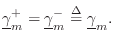
Typically, input signals are injected equally to the left and right along the string, in which case
![\begin{displaymath}
\underbrace{\left[\!
\begin{array}{c}
\vdots\\
y^{+}_{n+2,m...
...ine{\upsilon}(n+1)
\end{array}\!\right]}_{\underline{u}(n+2)}.
\end{displaymath}](http://www.dsprelated.com/josimages_new/pasp/img4655.png)
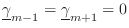 ), such as in a half-rate staggered grid
scheme, the input reduces to
), such as in a half-rate staggered grid
scheme, the input reduces to
![\begin{displaymath}
\underline{x}_W(n+2) = \mathbf{A}_W\underline{x}_W(n) +
\un...
...d{array}\!\right]}_{{\mathbf{B}_W}}
\underline{\upsilon}(n+2).
\end{displaymath}](http://www.dsprelated.com/josimages_new/pasp/img4657.png)
To show that the directly obtained FDTD and DW state-space models
correspond to the same dynamic system, it remains to verify that
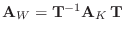 . It is somewhat easier to show that
![\begin{eqnarray*}
\mathbf{T}\,\mathbf{A}_W&=& \mathbf{A}_K\,\mathbf{T}\\
&=&
\l...
...dots & \vdots & \vdots & \vdots & \vdots
\end{array}\!\right].
\end{eqnarray*}](http://www.dsprelated.com/josimages_new/pasp/img4659.png)
A straightforward calculation verifies that the above identity holds,
as expected. One can similarly verify
 , as expected.
The relation
, as expected.
The relation
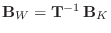 provides a recipe for translating any
choice of input signals for the FDTD model to equivalent inputs for
the DW model, or vice versa.
For example, in the scalar input case (
provides a recipe for translating any
choice of input signals for the FDTD model to equivalent inputs for
the DW model, or vice versa.
For example, in the scalar input case ( ), the DW input-weights
become FDTD input-weights
), the DW input-weights
become FDTD input-weights
 according to
![\begin{displaymath}
\left[\!
\begin{array}{l}
\qquad\vdots\\
y_{n+1,m-1}\\
y_{...
...psilon}(n+2)\\
\underline{\upsilon}(n+1)
\end{array}\!\right]
\end{displaymath}](http://www.dsprelated.com/josimages_new/pasp/img4662.png)
 results in
![$\displaystyle \mathbf{B}_K= \left[\! \begin{array}{cc} \vdots & \vdots\\ \gamma...
...ma _{m+1}+\gamma _{m+3} \\ [5pt] \vdots & \vdots \end{array} \!\right] \protect$](http://www.dsprelated.com/josimages_new/pasp/img4664.png)
Finally, when
 and
and
 for all
  , we obtain the
result familiar from Eq.(E.23):
, we obtain the
result familiar from Eq.(E.23):
![\begin{displaymath}
\mathbf{B}_K=
\left[\!
\begin{array}{cc}
\vdots & \vdots\\
...
...0 \\
2 & 0 \\
1 & 0 \\
\vdots & \vdots
\end{array}\!\right]
\end{displaymath}](http://www.dsprelated.com/josimages_new/pasp/img4668.png)
 for all
 , the weighting
pattern
, the weighting
pattern  appears in the second column, shifted down one row.
Thus,
in general (for physically stationary displacement inputs)
can be seen as the superposition of weight patterns in the
left column for even , and the right column for odd (the other
subgrid), where the
appears in the second column, shifted down one row.
Thus,
in general (for physically stationary displacement inputs)
can be seen as the superposition of weight patterns in the
left column for even , and the right column for odd (the other
subgrid), where the  is aligned with the driven sample.
This is the general collection of displacement inputs.
is aligned with the driven sample.
This is the general collection of displacement inputs.
DW Non-Displacement Inputs
Since a displacement input at position corresponds to
symmetrically exciting the right- and left-going traveling-wave
components  and
and  , it is of interest to understand what
it means to excite these components antisymmetrically. As
discussed in §E.3.3, an antisymmetric excitation of
traveling-wave components can be interpreted as a velocity
excitation. It was noted that localized velocity excitations in the
FDTD generally correspond to non-localized velocity excitations in the
DW, and that velocity in the DW is proportional to the spatial
derivative of the difference between the left-going and right-going
traveling displacement-wave components (see Eq.(E.13)). More
generally, the antisymmetric component of displacement-wave excitation
can be expressed in terms of any wave variable which is linearly
independent relative to displacement, such as acceleration, slope,
force, momentum, and so on. Since the state space of a vibrating
string (and other mechanical systems) is traditionally taken to be
position and velocity, it is perhaps most natural to relate the
antisymmetric excitation component to velocity.
, it is of interest to understand what
it means to excite these components antisymmetrically. As
discussed in §E.3.3, an antisymmetric excitation of
traveling-wave components can be interpreted as a velocity
excitation. It was noted that localized velocity excitations in the
FDTD generally correspond to non-localized velocity excitations in the
DW, and that velocity in the DW is proportional to the spatial
derivative of the difference between the left-going and right-going
traveling displacement-wave components (see Eq.(E.13)). More
generally, the antisymmetric component of displacement-wave excitation
can be expressed in terms of any wave variable which is linearly
independent relative to displacement, such as acceleration, slope,
force, momentum, and so on. Since the state space of a vibrating
string (and other mechanical systems) is traditionally taken to be
position and velocity, it is perhaps most natural to relate the
antisymmetric excitation component to velocity.
In practice, the simplest way to handle a velocity input  in a
DW simulation is to first pass it through a first-order integrator of the
form
in a
DW simulation is to first pass it through a first-order integrator of the
form

to convert it to a displacement input. By the equivalence of the DW and FDTD models, this works equally well for the FDTD model. However, in view of §E.3.3, this approach does not take full advantage of the ability of the FDTD scheme to provide localized velocity inputs for applications such as simulating a piano hammer strike. The FDTD provides such velocity inputs for ``free'' while the DW requires the external integrator Eq.
(E.37).
Note, by the way, that these ``integrals'' (both that done internally
by the FDTD and that done by Eq.(E.37)) are merely sums over
discrete time--not true integrals. As a result, they are exact only
at dc (and also trivially at  , where the output amplitude is
zero). Discrete sums can also be considered exact integrators for
impulse-train inputs--a point of view sometimes useful when
interpreting simulation results. For normal bandlimited signals,
discrete sums most accurately approximate integrals in a neighborhood
of dc. The KW-converter filter
, where the output amplitude is
zero). Discrete sums can also be considered exact integrators for
impulse-train inputs--a point of view sometimes useful when
interpreting simulation results. For normal bandlimited signals,
discrete sums most accurately approximate integrals in a neighborhood
of dc. The KW-converter filter
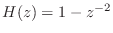 has analogous
properties.
has analogous
properties.
Input Locality
The DW state-space model is given in terms of the FDTD state-space
model by Eq.(E.31). The similarity transformation matrix
is
bidiagonal, so that
 and
are both approximately
diagonal when the output is string displacement for all . However,
since
given in Eq.(E.11) is upper triangular, the input matrix
and
are both approximately
diagonal when the output is string displacement for all . However,
since
given in Eq.(E.11) is upper triangular, the input matrix
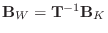 can replace sparse input matrices
with only
half-sparse
, unless successive columns of
are equally
weighted, as discussed in §E.3. We can say that local
K-variable excitations may correspond to non-local W-variable
excitations. From Eq.(E.35) and Eq.(E.36), we see that
displacement inputs are always local in both systems.
Therefore, local FDTD and non-local DW excitations can only occur when
a variable dual to displacement is being excited, such as velocity.
If the external integrator Eq.(E.37) is used, all inputs are
ultimately displacement inputs, and the distinction disappears.
can replace sparse input matrices
with only
half-sparse
, unless successive columns of
are equally
weighted, as discussed in §E.3. We can say that local
K-variable excitations may correspond to non-local W-variable
excitations. From Eq.(E.35) and Eq.(E.36), we see that
displacement inputs are always local in both systems.
Therefore, local FDTD and non-local DW excitations can only occur when
a variable dual to displacement is being excited, such as velocity.
If the external integrator Eq.(E.37) is used, all inputs are
ultimately displacement inputs, and the distinction disappears.
Next Section:
Boundary Conditions
Previous Section:
FDTD State Space Model