







Damping and Tuning Parameters
The tuning and damping of the resonator impulse response are governed by the relation
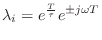
 denotes the sampling interval,
  is the time constant
of decay, and
is the time constant
of decay, and  is the frequency of oscillation in radians per
second. The eigenvalues are presumed to be complex, which requires,
from Eq.
is the frequency of oscillation in radians per
second. The eigenvalues are presumed to be complex, which requires,
from Eq. (C.144),

To obtain a specific decay time-constant , we must have
![\begin{eqnarray*}
e^{-2T/\tau} &=& \left\vert{\lambda_i}\right\vert^2 = c^2\left...
...left[g(1-c^2) - c^2\left(\frac{1-g}{2}\right)^2\right]\\
&=& g
\end{eqnarray*}](http://www.dsprelated.com/josimages_new/pasp/img4234.png)
Therefore, given a desired decay time-constant (and the
sampling interval ), we may compute the damping parameter  for
the digital waveguide resonator as
for
the digital waveguide resonator as
 (C.140), provided it is known that the poles form
a complex-conjugate pair.
(C.140), provided it is known that the poles form
a complex-conjugate pair.
To obtain a desired frequency of oscillation, we must solve
![\begin{eqnarray*}
\theta = \omega T
&=& \tan^{-1}\left[\frac{\sqrt{g(1-c^2) - [...
...,\tan^2{\theta} &=& \frac{g(1-c^2) - [c(1-g)/2]^2}{[c(1+g)/2]^2}
\end{eqnarray*}](http://www.dsprelated.com/josimages_new/pasp/img4236.png)
for  , which yields

 when
when  (undamped case).
Next Section:
Eigenvalues in the Undamped Case
Previous Section:
Miscellaneous Properties












