







Delay-Line Damping Filter Design
Let
 denote the desired reverberation time at radian frequency
 , and let
  denote the transfer function of the lowpass
filter to be placed in series with the
denote the transfer function of the lowpass
filter to be placed in series with the  th delay line which is
  samples long. The problem we consider now is how to design these
filters to yield the desired reverberation time. We will specify an
ideal amplitude response for based on the desired
reverberation time at each frequency, and then use conventional
filter-design methods to obtain a low-order approximation to this
ideal specification.
samples long. The problem we consider now is how to design these
filters to yield the desired reverberation time. We will specify an
ideal amplitude response for based on the desired
reverberation time at each frequency, and then use conventional
filter-design methods to obtain a low-order approximation to this
ideal specification.
In accordance with Eq. (3.6), the lowpass filter in series
with a length delay line should approximate
(3.6), the lowpass filter in series
with a length delay line should approximate
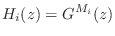
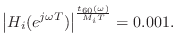
 of both sides gives
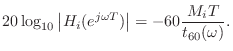
This is the same formula derived by Jot [217] using a somewhat different approach.
Now that we have specified the ideal delay-line filter
 in
terms of its amplitude response in dB, any number of filter-design
methods can be used to find a low-order which provides a good
approximation to satisfying Eq.(3.9). Examples include the functions
invfreqz and stmcb in Matlab. Since the variation
in reverberation time is typically very smooth with respect to
, the filters can be very low order.
in
terms of its amplitude response in dB, any number of filter-design
methods can be used to find a low-order which provides a good
approximation to satisfying Eq.(3.9). Examples include the functions
invfreqz and stmcb in Matlab. Since the variation
in reverberation time is typically very smooth with respect to
, the filters can be very low order.
First-Order Delay-Filter Design
The first-order case is very simple while enabling separate control of
low-frequency and high-frequency reverberation times. For simplicity,
let's specify  and
and
 , denoting the desired
decay-time at dc (
, denoting the desired
decay-time at dc ( ) and half the sampling rate
(
) and half the sampling rate
(
 ). Then we have determined the coefficients of a
one-pole filter:
). Then we have determined the coefficients of a
one-pole filter:
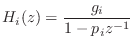
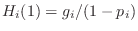 , while the gain at
is
, while the gain at
is
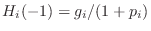 . From Eq.(3.9) (or
Eq.(3.8)), we obtain two equations in two unknowns:
. From Eq.(3.9) (or
Eq.(3.8)), we obtain two equations in two unknowns:
![\begin{eqnarray*}
\frac{g_i}{1-p_i} &=& 10^{-3 M_i T / t_{60}(0)}
\eqsp e^{-M_iT...
...(\pi/T)}
\eqsp e^{-M_iT/\tau(\pi/T)} \isdefs R_\pi^{M_i}\\ [5pt]
\end{eqnarray*}](http://www.dsprelated.com/josimages_new/pasp/img870.png)
where
 denotes the th delay-line length in
seconds. These two equations are readily solved to yield
denotes the th delay-line length in
seconds. These two equations are readily solved to yield
![\begin{eqnarray*}
p_i &=& \frac{R_0^{M_i}-R_\pi^{M_i}}{R_0^{M_i}+R_\pi^{M_i}}\\ [5pt]
g_i &=& \frac{2R_0^{M_i}R_\pi^{M_i}}{R_0^{M_i}+R_\pi^{M_i}}
\end{eqnarray*}](http://www.dsprelated.com/josimages_new/pasp/img872.png)
The truncated series approximation

Orthogonalized First-Order Delay-Filter Design
In [217], first-order delay-line filters of the form
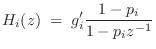
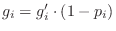 . This form has the
advantage that the dc gain is always
. This form has the
advantage that the dc gain is always
 for all (stable)
values of
for all (stable)
values of  . Therefore, we can set
  to give a desired
reverberation time at dc, and not have to change it when is
varied to modulate the high-frequency decay rate. As in the previous
section, from Eq.(3.9), we obtain
to give a desired
reverberation time at dc, and not have to change it when is
varied to modulate the high-frequency decay rate. As in the previous
section, from Eq.(3.9), we obtain
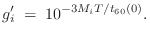

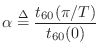
denotes the ratio of reverberation time at half the sampling rate divided by the reverberation time at dc.4.16
Multiband Delay-Filter Design
In §3.7.5, we derived first-order FDN delay-line filters which
can independently set the reverberation time at dc and at half the
sampling rate. However, perceptual studies indicate that
reverberation time should be independently adjustable in at least
three frequency bands [217]. To provide this degree
of control (and more), one can implement a multiband delay-line filter
using a general-purpose filter bank
[370,500]. The output, say, of each delay
line is split into  bands, where
  is recommended, and then,
from Eq.(3.6), the gain in the
is recommended, and then,
from Eq.(3.6), the gain in the  th band for a length
delay-line can be set to
th band for a length
delay-line can be set to

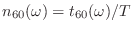 denotes the desired 60-dB decay
time in samples. Faust implementations of FDN reverberator along
these lines are described in §3.7.9 below.
denotes the desired 60-dB decay
time in samples. Faust implementations of FDN reverberator along
these lines are described in §3.7.9 below.
Next Section:
Spectral Coloration Equalizer
Previous Section:
Achieving Desired Reverberation Times












