Delay Operator Notation
It is convenient to think of the FDA in terms of time-domain
difference operators using a delay operator notation. The
delay operator  is defined by
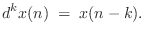
 . We can think of as
 since, by the shift theorem for
  transforms,
 is the transform of
  delayed (right shifted) by
  samples.
The obvious definition for the second derivative is
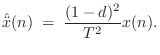
However, a better definition is the centered finite difference

where
 denotes a unit-sample advance. This definition
is preferable as long as one sample of look-ahead is available, since
it avoids an operator delay of one sample. Equation (7.5) is a
zero phase filter, meaning it has no delay at any frequency,
while (7.4) is a linear phase filter having a delay of
denotes a unit-sample advance. This definition
is preferable as long as one sample of look-ahead is available, since
it avoids an operator delay of one sample. Equation (7.5) is a
zero phase filter, meaning it has no delay at any frequency,
while (7.4) is a linear phase filter having a delay of
 sample at all frequencies.
Next Section:
Finite Difference Approximation vs. Bilinear Transform
Previous Section:
FDA in the Frequency Domain