Digital Waveguide Interpolation
A more compact simulation diagram which stands for either sampled or
continuous waveguide simulation is shown in Fig.C.4.
The figure emphasizes that the ideal, lossless waveguide is simulated
by a bidirectional delay line, and that bandlimited
spatial interpolation may be used to construct a displacement
output for an arbitrary  not a multiple of
  , as suggested by
the output drawn in Fig.C.4. Similarly, bandlimited
interpolation across time serves to evaluate the waveform at an
arbitrary time not an integer multiple of
, as suggested by
the output drawn in Fig.C.4. Similarly, bandlimited
interpolation across time serves to evaluate the waveform at an
arbitrary time not an integer multiple of  (§4.4).
![\includegraphics[scale=0.9]{eps/fcompact}](http://www.dsprelated.com/josimages_new/pasp/img3301.png)
Ideally, bandlimited interpolation is carried out by convolving a
continuous ``sinc function''
sinc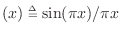 with the signal samples. Specifically, convolving a sampled signal
 with
sinc
with
sinc![$ [(t_n-t_0)/T)]$](http://www.dsprelated.com/josimages_new/pasp/img3304.png) ``evaluates'' the signal at an
arbitrary continuous time
``evaluates'' the signal at an
arbitrary continuous time  . The sinc function is the impulse
response of the ideal lowpass filter which cuts off at half the
sampling rate.
. The sinc function is the impulse
response of the ideal lowpass filter which cuts off at half the
sampling rate.
In practice, the interpolating sinc function must be windowed
to a finite duration. This means the associated lowpass filter must
be granted a ``transition band'' in which its frequency response is
allowed to ``roll off'' to zero at half the sampling rate. The
interpolation quality in the ``pass band'' can always be made perfect
to within the resolution of human hearing by choosing a sufficiently
large product of window-length times transition-bandwidth. Given
``audibly perfect'' quality in the pass band, increasing the
transition bandwidth reduces the computational expense of the
interpolation. In fact, they are approximately inversely
proportional. This is one reason why oversampling at rates
higher than twice the highest audio frequency is helpful. For
example, at a  kHz sampling rate, the transition bandwidth above
the nominal audio upper limit of
kHz sampling rate, the transition bandwidth above
the nominal audio upper limit of  kHz is only
  kHz, while at
a
kHz, while at
a  kHz sampling rate (used in DAT machines) the guard band is
  kHz wide--nearly double. Since the required window length (impulse
response duration) varies inversely with the provided transition
bandwidth, we see that increasing the sampling rate by less than ten
percent reduces the filter expense by almost fifty percent.
Windowed-sinc interpolation is described further in
§4.4. Many more techniques for digital resampling
and delay-line interpolation are reviewed in
[267].
kHz wide--nearly double. Since the required window length (impulse
response duration) varies inversely with the provided transition
bandwidth, we see that increasing the sampling rate by less than ten
percent reduces the filter expense by almost fifty percent.
Windowed-sinc interpolation is described further in
§4.4. Many more techniques for digital resampling
and delay-line interpolation are reviewed in
[267].
Next Section:
Relation to the Finite Difference Recursion
Previous Section:
Digital Waveguide Model