Digitizing Bridge Reflectance
Converting continuous-time transfer functions such as
 and
and
 to the digital domain is analogous to converting an analog
electrical filter to a corresponding digital filter--a problem which
has been well studied [343]. For this task, the
bilinear transform (§7.3.2) is a good choice. In
addition to preserving order and being free of aliasing, the bilinear
transform preserves the positive-real property of passive impedances
(§C.11.2).
to the digital domain is analogous to converting an analog
electrical filter to a corresponding digital filter--a problem which
has been well studied [343]. For this task, the
bilinear transform (§7.3.2) is a good choice. In
addition to preserving order and being free of aliasing, the bilinear
transform preserves the positive-real property of passive impedances
(§C.11.2).
Digitizing
via the bilinear transform (§7.3.2)
transform gives
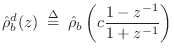
 approaches zero. The choice of
bilinear-transform constant
approaches zero. The choice of
bilinear-transform constant
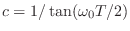 maps the
peak-frequency
maps the
peak-frequency  without error (see Problem 4).
Next Section:
A Two-Resonance Guitar Bridge
Previous Section:
Bridge Transmittance