







EDR-Based Loop-Filter Design
This section discusses use of the Energy Decay Relief (EDR) (§3.2.2) to measure the decay times of the partial overtones in a recorded vibrating string.
First we derive what to expect in the case of a simplified string
model along the lines discussed in §6.7 above. Assume we
have the synthesis model of Fig.6.12, where now the loss
factor  is replaced by the digital filter
  that we wish
to design. Let
that we wish
to design. Let
 denote the contents of the delay line as a
vector at time
denote the contents of the delay line as a
vector at time  , with
 denoting the initial contents of the
delay line.
denoting the initial contents of the
delay line.
For simplicity, we define the EDR based on a length  DFT of the delay-line
vector
DFT of the delay-line
vector
 , and use a rectangular window with a ``hop size'' of samples,
i.e.,
, and use a rectangular window with a ``hop size'' of samples,
i.e.,

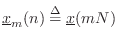 .
That is
.
That is
 is
simply the
is
simply the  th successive snapshot of the delay-line contents, where
the snapshots are taken once every samples.
We may interpret
th successive snapshot of the delay-line contents, where
the snapshots are taken once every samples.
We may interpret
 as th short-time
spectrum of the output signal
as th short-time
spectrum of the output signal  shown in Fig.6.12. Due
to the special structure of our synthesis model, we have
shown in Fig.6.12. Due
to the special structure of our synthesis model, we have

![$ k\in[0,N-1]$](http://www.dsprelated.com/josimages_new/pasp/img1481.png) .
.
Applying the definition of the EDR (§3.2.2) to this short-time spectrum gives
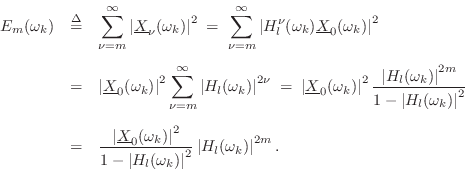
We therefore have the following recursion for successive EDR time-slices:7.13


 is dropped for notational
simplicity.
Since we require
is dropped for notational
simplicity.
Since we require
 for stability of the filtered-delay loop, the EDR
decays monotonically in this example. Thus, the measured slope of the
partial overtone decays will be found to be proportional to
for stability of the filtered-delay loop, the EDR
decays monotonically in this example. Thus, the measured slope of the
partial overtone decays will be found to be proportional to
 .
.
This analysis can be generalized to a time-varying model in which the
loop filter  is allowed to change once per ``period''
.7.14
is allowed to change once per ``period''
.7.14
An online laboratory exercise covering the practical details of measuring overtone decay-times and designing a corresponding loop filter is given in [280].
Next Section:
Horizontal and Vertical Transverse Waves
Previous Section:
Fundamental Frequency Estimation












