Eigenvalues in the Undamped Case
When  , the eigenvalues reduce to
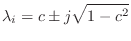
 , the eigenvalues can be expressed as

where
 denotes the angular advance per sample of the
oscillator. Since
denotes the angular advance per sample of the
oscillator. Since
 corresponds to the range
 , we see that
  in this range can produce
oscillation at any digital frequency.
in this range can produce
oscillation at any digital frequency.
For
 , the eigenvalues are real, corresponding to
exponential growth and/or decay. (The values
, the eigenvalues are real, corresponding to
exponential growth and/or decay. (The values  were
excluded above in deriving Eq.
were
excluded above in deriving Eq. (C.144).)
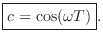
In summary, the coefficient in the digital waveguide oscillator
() and the frequency of sinusoidal oscillation  is simply
Next Section:
Overview of Methods
Previous Section:
Damping and Tuning Parameters