Energy Decay Curve
For measuring and defining reverberation time  , Schroeder
introduced the so-called
energy decay curve (EDC) which is the tail integral of the squared impulse
response at time
, Schroeder
introduced the so-called
energy decay curve (EDC) which is the tail integral of the squared impulse
response at time  :
:
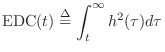
 is the total amount of signal energy remaining in the
reverberator impulse response at time . The EDC decays more
smoothly than the impulse response itself, and so it is more useful
than ordinary amplitude envelopes for estimating .
is the total amount of signal energy remaining in the
reverberator impulse response at time . The EDC decays more
smoothly than the impulse response itself, and so it is more useful
than ordinary amplitude envelopes for estimating .
Next Section:
Energy Decay Relief
Previous Section:
Efficiency of Diagonalized State-Space Models