Energy Decay through Lossy Boundaries
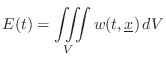
Since the acoustic energy density  is the energy per unit
volume in a 3D sound field, it follows that the total energy of the
field is given by integrating over the volume:
is the energy per unit
volume in a 3D sound field, it follows that the total energy of the
field is given by integrating over the volume:
 in time interval
  must equal the acoustic intensity
 exiting the volume,
times (approximating
exiting the volume,
times (approximating  as constant between times
  and
and
 ):
):
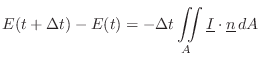
 is the dot-product of the (vector)
intensity
is the dot-product of the (vector)
intensity
 with a unit-vector
 chosen to be normal to the
surface at position
chosen to be normal to the
surface at position
 along the surface. Thus,
 is
the component of the acoustic intensity
exiting the volume
normal to its surface. (The tangential component does not exit.)
Dividing through by and taking a limit as
is
the component of the acoustic intensity
exiting the volume
normal to its surface. (The tangential component does not exit.)
Dividing through by and taking a limit as
 yields the following conservation law, originally published by
Kirchoff in 1867:
yields the following conservation law, originally published by
Kirchoff in 1867:
 is
equal to the surface integral of the power crossing its boundary. A
more detailed derivation appears in [349, p. 37].
is
equal to the surface integral of the power crossing its boundary. A
more detailed derivation appears in [349, p. 37].
Sabine's theory of acoustic energy decay in reverberant room impulse responses can be derived using this conservation relation as a starting point.
Next Section:
Ideal Gas Law
Previous Section:
Acoustic Energy Density