Energy Decay Relief
The energy decay relief (EDR) is a time-frequency distribution which generalizes the EDC to multiple frequency bands [215]:
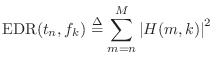
 denotes bin
  of the short-time Fourier transform
(STFT) at time-frame
of the short-time Fourier transform
(STFT) at time-frame  [12,451], and
  denotes the total number of time frames. The FFT within the STFT is
typically used with a window, such as a Hann window of length 30 or 40
ms.
denotes the total number of time frames. The FFT within the STFT is
typically used with a window, such as a Hann window of length 30 or 40
ms.
Thus,
 is the total amount of signal energy remaining
in the reverberator's impulse response at time
is the total amount of signal energy remaining
in the reverberator's impulse response at time  in a frequency band centered
about
in a frequency band centered
about
 Hz, where
  denotes the FFT length.
The EDR of a violin-body impulse response is shown in Fig.3.2. For better correspondence with audio perception, the frequency axis is warped to the Bark frequency scale [459], and energy is summed within each Bark band (one critical band of hearing equals one Bark). A violin body can be regarded as a very small reverberant room, with correspondingly ``magnified'' spectral structure relative to reverberant rooms.
![\includegraphics[width=\twidth]{eps/bodyBEDR}](http://www.dsprelated.com/josimages_new/pasp/img693.png)
The EDR of the Boston Symphony Hall is displayed in [153, p. 96].
The EDR is used to measure partial overtone dampings from recordings of a vibrating string in §6.11.5.
Next Section:
Hadamard Matrix
Previous Section:
Energy Decay Curve