







Exact Reverb via Transfer-Function Modeling
Figure 3.1 depicts the general reverberation scenario for three sources and one listener (two ears). In general, the filters should also include filtering by the pinnae of the ears, so that each echo can be perceived as coming from the correct angle of arrival in 3D space; in other words, at least some reverberant reflections should be spatialized so that they appear to come from their natural directions in 3D space [248]. Again, the filters change if anything changes in the listening space, including source or listener position. The artificial reverberation problem is then to implement some approximation of the system in Fig.3.1.
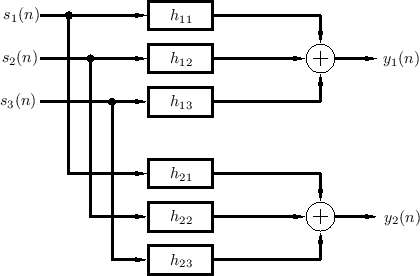 |
In the frequency domain, it is convenient to express the input-output relationship in terms of the transfer-function matrix:
![$\displaystyle \left[\begin{array}{c} Y_1(z) \\ [2pt] Y_2(z) \end{array}\right] ...
...left[\begin{array}{c} S_1(z) \\ [2pt] S_2(z) \\ [2pt] S_3(z)\end{array}\right]
$](http://www.dsprelated.com/josimages_new/pasp/img663.png)
Denoting the impulse response of the filter from source  to ear
  by
by  , the two output signals in Fig.3.1 are computed by
six convolutions:
, the two output signals in Fig.3.1 are computed by
six convolutions:

 denotes the order of FIR filter
  . Since many
of the filter coefficients are zero (at least for small
. Since many
of the filter coefficients are zero (at least for small
 ), it is more efficient to implement them as tapped delay
lines (§2.5) so that the inner sum becomes sparse.
For greater accuracy, each tap may include a lowpass
filter which models air absorption [314] and/or
spherical spreading loss (see §2.3).
For large ,
the impulse responses are not sparse, and we must either implement
very expensive FIR filters, or approximate the tail of the impulse
response using less expensive IIR filters; this subject--``late
reverberation'' approximation--is taken up in §3.4.
), it is more efficient to implement them as tapped delay
lines (§2.5) so that the inner sum becomes sparse.
For greater accuracy, each tap may include a lowpass
filter which models air absorption [314] and/or
spherical spreading loss (see §2.3).
For large ,
the impulse responses are not sparse, and we must either implement
very expensive FIR filters, or approximate the tail of the impulse
response using less expensive IIR filters; this subject--``late
reverberation'' approximation--is taken up in §3.4.
Next Section:
Complexity of Exact Reverberation
Previous Section:
Digital Waveguide Networks












