Exercises in Wave Digital Modeling
- Comparing digital and analog frequency formulas.
This first exercise verifies that the elementary ``tank circuit''
always resonates at exactly the frequency it should, according to the
bilinear transform frequency mapping
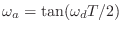 , where
  denotes ``analog frequency'' and
  denotes ``digital frequency''.
- Find the poles of Fig.F.35 in terms of
 .
.
- Show that the resonance frequency is given by
where

 denotes the sampling rate.
- Recall that the mass-spring oscillator resonates at
 . Relate these two resonance frequency formulas
via the analog-digital frequency map
.
. Relate these two resonance frequency formulas
via the analog-digital frequency map
.
- Show that the trig identity you discovered in this way is true.
I.e., show that
![$\displaystyle f_s \arccos\left[\frac{k-m}{k+m}\right] =
2f_s \arctan\left[\sqrt{\frac{m}{k}}\right].
$](http://www.dsprelated.com/josimages_new/pasp/img5051.png)
- Find the poles of Fig.F.35 in terms of
Previous Section:
Energy-Preserving Parameter Changes (Mass-Spring Oscillator)