Exponentially Decaying Traveling Waves
Let
 denote the decay factor associated with
propagation of a plane wave over distance
denote the decay factor associated with
propagation of a plane wave over distance  at frequency
 rad/sec. For an ideal plane wave, there is no ``spreading
loss'' (attenuation by
rad/sec. For an ideal plane wave, there is no ``spreading
loss'' (attenuation by  ). Under uniform conditions, the
amount of attenuation (in dB) is proportional to the distance
traveled; in other words, the attenuation factors for two successive
segments of a propagation path are multiplicative:
). Under uniform conditions, the
amount of attenuation (in dB) is proportional to the distance
traveled; in other words, the attenuation factors for two successive
segments of a propagation path are multiplicative:

 is an exponential function of
distance .3.3
is an exponential function of
distance .3.3
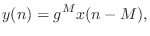
Frequency-independent air absorption is easily modeled in an acoustic simulation by making the substitution
 denotes the attenuation associated with propagation during one
sampling period (
denotes the attenuation associated with propagation during one
sampling period ( seconds). Thus, to simulate absorption
corresponding to an
seconds). Thus, to simulate absorption
corresponding to an  -sample delay, the difference equation
Eq.
-sample delay, the difference equation
Eq. (2.1) on page
 ![[*]](../icons/crossref.png) becomes
becomes
Next Section:
Frequency-Dependent Air-Absorption Filtering
Previous Section:
Program for Acoustic Echo Simulation