







Extracting Physical Quantities
Since we are using a force-wave simulation, the state variable  (delay element output) is in units of physical force (newtons).
Specifically,
(delay element output) is in units of physical force (newtons).
Specifically,
 . (The physical force is, of
course, 0, while its traveling-wave components are not 0 unless the
mass is at rest.) Using the fundamental relations relating traveling
force and velocity waves
. (The physical force is, of
course, 0, while its traveling-wave components are not 0 unless the
mass is at rest.) Using the fundamental relations relating traveling
force and velocity waves
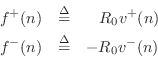
where  here, it is easy to convert the state variable to
other physical units, as we now demonstrate.
here, it is easy to convert the state variable to
other physical units, as we now demonstrate.
The velocity of the mass, for example, is given by
 can be scaled by
  to ``read out''
the mass velocity.
to ``read out''
the mass velocity.
The kinetic energy of the mass is given by
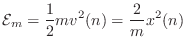 can be scaled by
to produce the physical kinetic energy associated with the mass.
can be scaled by
to produce the physical kinetic energy associated with the mass.
Next Section:
A More Formal Derivation of the Wave Digital Force-Driven Mass
Previous Section:
Series Reflection Free Port












