







FDN Stability
Stability of the FDN is assured when some norm [451] of
the state vector
 decreases over time when the input signal is
zero [220, ``Lyapunov stability theory'']. That is, a
sufficient condition for FDN stability is
decreases over time when the input signal is
zero [220, ``Lyapunov stability theory'']. That is, a
sufficient condition for FDN stability is

for all
 , where
 denotes the norm of
, and
denotes the norm of
, and
![$\displaystyle \mathbf{x}(n+1) = \mathbf{A}\left[\begin{array}{c} x_1(n-M_1) \\ [2pt] x_2(n-M_2) \\ [2pt] x_3(n-M_3)\end{array}\right].
$](http://www.dsprelated.com/josimages_new/pasp/img567.png)
 (2.12) holds under the
  norm [451]
whenever the feedback matrix
norm [451]
whenever the feedback matrix
 in Eq.(2.6) satisfies
[473]
in Eq.(2.6) satisfies
[473]
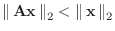
for all
 , where
 denotes the norm, defined by
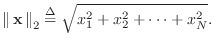 norm of its input vector.
The matrix norm corresponding to any vector norm
 may be defined for the matrix
as
may be defined for the matrix
as
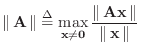
 denotes the norm of the vector
. In other
words, the matrix norm ``induced'' by a vector
norm is given by the maximum of
denotes the norm of the vector
. In other
words, the matrix norm ``induced'' by a vector
norm is given by the maximum of
 over all
unit-length vectors
in the space. When the vector norm is the
norm, the induced matrix norm is often called the
spectral norm. Thus, Eq.(2.13) can be restated as
over all
unit-length vectors
in the space. When the vector norm is the
norm, the induced matrix norm is often called the
spectral norm. Thus, Eq.(2.13) can be restated as

where
 denotes the spectral norm of
.
denotes the spectral norm of
.
It can be shown [167] that the spectral norm of a matrix
is given by the largest singular value of
(``
 ''), and that this is equal to the
square-root of the largest eigenvalue of
''), and that this is equal to the
square-root of the largest eigenvalue of
 , where
 denotes the matrix transpose of the real matrix
.3.11
denotes the matrix transpose of the real matrix
.3.11
Since every orthogonal matrix
 has spectral norm
1,3.12 a wide variety of stable
feedback matrices can be parametrized as
has spectral norm
1,3.12 a wide variety of stable
feedback matrices can be parametrized as
 is any orthogonal matrix, and
 is a diagonal
matrix having entries less than 1 in magnitude:
is a diagonal
matrix having entries less than 1 in magnitude:
![$\displaystyle {\bm \Gamma}= \left[ \begin{array}{cccc}
g_1 & 0 & \dots & 0\\
0...
...\\
0 & 0 & \dots & g_N
\end{array}\right], \quad \left\vert g_i\right\vert<1.
$](http://www.dsprelated.com/josimages_new/pasp/img587.png)
An alternative stability proof may be based on showing that an FDN is
a special case of a passive digital waveguide network (derived in
§C.15). This analysis reveals that the FDN is lossless if
and only if the feedback matrix
has unit-modulus eigenvalues
and linearly independent eigenvectors.
Next Section:
Allpass from Two Combs
Previous Section:
Single-Input, Single-Output (SISO) FDN












