







Feedback Comb Filter Amplitude Response
Figure 2.26 shows a family of feedback-comb-filter amplitude responses, obtained using a selection of feedback coefficients.
![\includegraphics[width=\twidth ]{eps/fbcfar}](http://www.dsprelated.com/josimages_new/pasp/img505.png) |
 (Fig.
(Fig. and
and
 ) with
 Figure 2.27 shows a similar family obtained using negated feedback coefficients; the opposite sign of the feedback exchanges the peaks and valleys in the amplitude response.
![\includegraphics[width=\twidth ]{eps/fbcfiar}](http://www.dsprelated.com/josimages_new/pasp/img506.png) |
 ,
,  , and
, and  .
a) Linear amplitude scale. b)
.
a) Linear amplitude scale. b) As introduced in §2.6.2 above, a class of feedback comb filters can be defined as any difference equation of the form

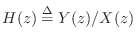 ,
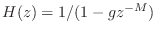
the transfer function of the feedback comb filter is found to be
,
the transfer function of the feedback comb filter is found to be
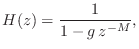
so that the amplitude response is

 and
and  ,
,  , and
, and
 . Figure 2.27 shows the same case but with the feedback
sign-inverted.
. Figure 2.27 shows the same case but with the feedback
sign-inverted.
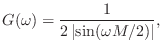
For  , the feedback-comb amplitude response
reduces to
, the feedback-comb amplitude response
reduces to
 to
to
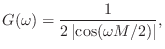 (Eq.
(Eq. (2.4)).
Note that  produces resonant peaks at

 , the peaks occur midway between these values.
Next Section:
Filtered-Feedback Comb Filters
Previous Section:
Feedforward Comb Filter Amplitude Response












