Sign in

username:

password:


Not a member?

Search Online Books


Search tips

Free Online Books

Ads

Chapters

See Also

Embedded SystemsFPGAElectronics
Chapter Contents:

Search Physical Audio Signal Processing


Book Index | Global Index


Would you like to be notified by email when Julius Orion Smith III publishes a new entry into his blog?


Feedback Comb Filters

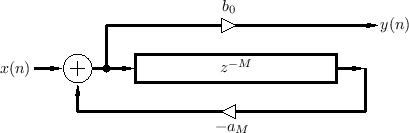
The feedback comb filter uses feedback instead of a feedforward signal, as shown in Fig.1.18 (drawn in ``direct form 2'' [460]).

Figure 1.18: The feedback comb filter.
\begin{figure}\input fig/fbcf.pstex_t
\end{figure}

A difference equation describing the feedback comb filter can be written in ``direct form 1'' [460] as2.5

$\displaystyle y(n) = b_0 x(n) - a_M y(n-M).
$

The feedback comb filter is a special case of an Infinite Impulse Response (IIR) (``recursive'') digital filter, since there is feedback from the delayed output to the input [460]. The feedback comb filter can be regarded as a computational physical model of a series of echoes, exponentially decaying and uniformly spaced in time. For example, the special case

$\displaystyle y(n) = x(n) + g\, y(n-M)
$

is a computational model of an ideal plane wave bouncing back and forth between two parallel walls; in such a model, $ g$ represents the total round-trip attenuation (two wall-to-wall traversals, including two reflections).

For stability, the feedback coefficient $ a_M$ must be less than $ 1$ in magnitude, i.e., $ \left\vert a_M\right\vert<1$. Otherwise, if $ \left\vert a_M\right\vert>1$, each echo will be louder than the previous echo, producing a never-ending, growing series of echoes.

Sometimes the output signal is taken from the end of the delay line instead of the beginning, in which case the difference equation can be written as

$\displaystyle y(n) = b_M x(n-M) - a_M y(n-M) .
$

This choice of output merely delays the output signal by $ M$ samples.


Order a Hardcopy of Physical Audio Signal Processing

Previous: Feedforward Comb Filters

Next: Feedforward Comb Filter Amplitude Response

written by Julius Orion Smith III
Julius Smith's background is in electrical engineering (BS Rice 1975, PhD Stanford 1983). He is presently Professor of Music and Associate Professor (by courtesy) of Electrical Engineering at Stanford's Center for Computer Research in Music and Acoustics (CCRMA), teaching courses and pursuing research related to signal processing applied to music and audio systems. See http://ccrma.stanford.edu/~jos/ for details.


Comments


No comments yet for this page


Add a Comment
You need to login before you can post a comment (best way to prevent spam). ( Not a member? )