







Finite Difference Time Domain (FDTD) Scheme
As discussed in §C.2, we may use centered finite
difference approximations (FDA) for the
second-order partial derivatives in the wave equation to obtain a
finite difference scheme for numerically integrating the ideal
wave equation [481,311]:


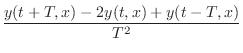

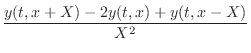
where
 is the time sampling interval, and
  is a spatial
sampling interval.
is a spatial
sampling interval.
Substituting the FDA into the wave equation, choosing  ,
where
,
where
 is sound speed (normalized to
  below), and sampling at times
  and positions
  , we
obtain the following explicit finite difference scheme for the string
displacement:
, we
obtain the following explicit finite difference scheme for the string
displacement:

where the sampling intervals
and have been normalized to
1. To initialize the recursion at time  , past values are needed
for all
, past values are needed
for all  (all points along the string) at time instants
  and
and
 . Then the string position may be computed for all by
Eq.
. Then the string position may be computed for all by
Eq. (E.3) for
 . This has been called the
FDTD or leapfrog finite difference scheme [127].
. This has been called the
FDTD or leapfrog finite difference scheme [127].
Next Section:
Digital Waveguide (DW) Scheme
Previous Section:
Convergence in Audio Applications












