Sign in

username:

password:


Not a member?

Search Online Books


Search tips

Free Online Books

Sponsor

Industry's highest performing at the lowest power DSPs now as low as $5.00*
Start development today!
*volume pricing for 10ku

Chapters

See Also

Embedded SystemsFPGAElectronics
Chapter Contents:

Search Physical Audio Signal Processing


Book Index | Global Index


Would you like to be notified by email when Julius Orion Smith III publishes a new entry into his blog?


Force Driving a Spring against a Wall

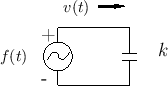
For this example, we have an external force $ f(n)$ driving a spring $ k$ which is terminated on the other end at a rigid wall. Figure F.16 shows the physical diagram and the electrical equivalent circuit is given in Fig.F.17.
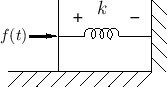
Figure F.16: External force driving a spring terminated by a rigid wall.
\includegraphics{eps/forcespring}

Figure: Electrical equivalent circuit of the compressed spring of Fig.F.16.
\includegraphics{eps/forcespringec}

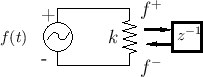
Figure F.18 depicts the insertion of an infinitesimal transmission line, and Fig.F.19 shows the result of converting the spring impedance to wave variable form.
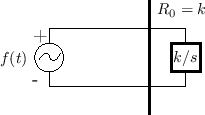
Figure F.18: Intermediate equivalent circuit for the force-driven spring in which an infinitesimal transmission line section has been inserted to facilitate conversion of the spring impedance $ k/s$ into a wave-variable reflectance.
\includegraphics{eps/forcespringscat}

Figure: Intermediate wave-variable model of Fig.F.17.
\includegraphics{eps/forcespringdt}

The two-port adaptor needed for this problem is the same as that for the force-driven mass, and the final result is shown in Fig.F.20.
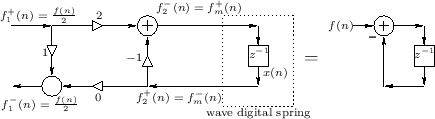
Figure F.20: Wave digital spring driven by external force $ f(n)$.
\includegraphics{eps/forcespringwdf}

Note that the spring model is being driven by a force from a zero source impedance, in contrast with the infinite source impedance interpretation of Fig.F.8b as a compressed spring. In this case, if the driving force goes to zero, the spring force goes immediately to zero (``free termination'') rather than remaining fixed.


Previous: A More Formal Derivation of the Wave Digital Force-Driven Mass
Next: Spring and Free Mass

Order a Hardcopy of Physical Audio Signal Processing


About the Author: Julius Orion Smith III
Julius Smith's background is in electrical engineering (BS Rice 1975, PhD Stanford 1983). He is presently Professor of Music and Associate Professor (by courtesy) of Electrical Engineering at Stanford's Center for Computer Research in Music and Acoustics (CCRMA), teaching courses and pursuing research related to signal processing applied to music and audio systems. See http://ccrma.stanford.edu/~jos/ for details.


Comments


No comments yet for this page


Add a Comment
You need to login before you can post a comment (best way to prevent spam). ( Not a member? )