Fractional Delay Filters
In fractional-delay filtering applications, the interpolator typically slides forward through time to produce a time series of interpolated values, thereby implementing a non-integer signal delay:

![$ \eta\in[-1/2,1/2]$](http://www.dsprelated.com/josimages_new/pasp/img1019.png) spans the central one-sample range of the
interpolator. Equivalently, the interpolator may be viewed as an FIR
filter having a linear phase response corresponding to a delay of
spans the central one-sample range of the
interpolator. Equivalently, the interpolator may be viewed as an FIR
filter having a linear phase response corresponding to a delay of
 samples. Such filters are often used in series with a delay
line in order to implement an interpolated delay line
(§4.1) that effectively provides a continuously
variable delay for discrete-time signals.
samples. Such filters are often used in series with a delay
line in order to implement an interpolated delay line
(§4.1) that effectively provides a continuously
variable delay for discrete-time signals.
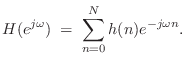
The frequency response [449] of the fractional-delay
FIR filter  is
is
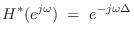
 denotes the total desired delay of
the filter. Thus, the ideal desired frequency response is a linear
phase term corresponding to a delay of
denotes the total desired delay of
the filter. Thus, the ideal desired frequency response is a linear
phase term corresponding to a delay of  samples.
Next Section:
Lagrange Interpolation Optimality
Previous Section:
Interpolation of Uniformly Spaced Samples