Frequency-Dependent Losses
In nearly all natural wave phenomena, losses increase with frequency. Distributed losses due to air drag and internal bulk losses in the string tend to increase monotonically with frequency. Similarly, air absorption increases with frequency, adding loss for sound waves in acoustic tubes or open air [318].
Perhaps the apparently simplest modification to Eq. (C.21) yielding
frequency-dependent damping is to add a third-order
time-derivative term [392]:
(C.21) yielding
frequency-dependent damping is to add a third-order
time-derivative term [392]:
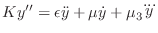
While this model has been successful in practice [77], it turns out to go unstable at very high sampling rates. The technical term for this problem is that the PDE is ill posed [45].
A well posed replacement for Eq.(C.28) is given by
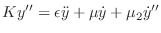
in which the third-order partial derivative with respect to time,
 , has been replaced by a third-order
mixed partial derivative--twice with respect to
, has been replaced by a third-order
mixed partial derivative--twice with respect to  and
once with respect to
and
once with respect to  .
.
The solution of a lossy wave equation containing higher odd-order
derivatives with respect to time yields traveling waves which
propagate with frequency-dependent attenuation. Instead of scalar
factors  distributed throughout the diagram as in Fig.C.5,
each factor becomes a lowpass filter having some
frequency-response per sample denoted by
distributed throughout the diagram as in Fig.C.5,
each factor becomes a lowpass filter having some
frequency-response per sample denoted by  . Because
propagation is passive, we will always have
. Because
propagation is passive, we will always have
 .
.
More specically, As shown in [392], odd-order partial derivatives with respect to time in the wave equation of the form

 , the losses are frequency
dependent, and the per-sample amplitude-response ``rolls off''
proportional to
, the losses are frequency
dependent, and the per-sample amplitude-response ``rolls off''
proportional to


 and
and
 , for instance, then the
per-sample propagation gain has the form
, for instance, then the
per-sample propagation gain has the form

 are constants depending on the constants
  and
and
 in the wave equation. Since these per-sample loss filters are
linear and time-invariant [449], they may also be consolidated
at a minimum number of points in the waveguide without introducing any
approximation error, just like the constant gains in Fig.C.5.
This result does not extend precisely to the waveguide mesh
(§C.14).
in the wave equation. Since these per-sample loss filters are
linear and time-invariant [449], they may also be consolidated
at a minimum number of points in the waveguide without introducing any
approximation error, just like the constant gains in Fig.C.5.
This result does not extend precisely to the waveguide mesh
(§C.14).
In view of the above, we see that we can add odd-order time
derivatives to the wave equation to approximate experimentally
observed frequency-dependent damping characteristics in vibrating
strings [73]. However, we then have the problem that
such wave equations are ill posed, leading to possible stability
failures at high sampling rates. As a result, it is generally
preferable to use mixed derivatives, as in Eq.(C.29), and try to
achieve realistic damping using higher order spatial derivatives
instead.
Next Section:
Well Posed PDEs for Modeling Damped Strings
Previous Section:
Loss Consolidation