Gerzon Nested MIMO Allpass
An interesting generalization of the single-input, single-output Schroeder allpass filter (defined in §2.8.1) was proposed by Gerzon [157] for use in artificial reverberation systems.
The starting point can be the first-order allpass of Fig.2.31a on
page ![[*]](../icons/crossref.png) , or the allpass made from two comb-filters depicted
in Fig.2.30 on
page .3.15In either case,
, or the allpass made from two comb-filters depicted
in Fig.2.30 on
page .3.15In either case,
- all signal paths are converted from scalars to vectors of dimension
 ,
,
- the delay element (or delay line) is replaced by an arbitrary
 unitary matrix frequency response.3.16
Let
 denote the
  input vector with components
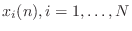 , and let
![$ \underline{X}(z)=[X_1(z),\dots,X_N(z)]$](http://www.dsprelated.com/josimages_new/pasp/img642.png) denote
the corresponding vector of z transforms. Denote the output
vector by
denote
the corresponding vector of z transforms. Denote the output
vector by
 . The resulting vector difference equation becomes,
in the frequency domain (cf. Eq.
. The resulting vector difference equation becomes,
in the frequency domain (cf. Eq. (2.15))

![$\displaystyle \mathbf{H}(z) = [\mathbf{I}+ g \mathbf{U}(z)]^{-1}[\overline{g}\mathbf{I}+ \mathbf{U}(z)]
$](http://www.dsprelated.com/josimages_new/pasp/img644.png)
 denotes the identity matrix, and
 denotes any paraunitary matrix transfer function
[500], [449, Appendix C].
denotes any paraunitary matrix transfer function
[500], [449, Appendix C].
Note that to avoid implementing
twice,
 should
be realized in vector direct-form II, viz.,
should
be realized in vector direct-form II, viz.,

where  denotes the unit-delay operator (
 ).
).
To avoid a delay-free loop, the paraunitary matrix must include at
least one pure delay in every row, i.e.,
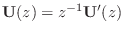 where
where
 is paraunitary and causal.
In [157], Gerzon suggested using
of the form
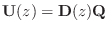
 is a simple orthogonal matrix, and
![$\displaystyle \mathbf{D}(z) = \left[ \begin{array}{ccccc} z^{-m_1} & 0 & 0 & \d...
...ts & \ddots& \vdots\\ 0 & 0 & 0 & \dots & z^{-m_N} \end{array} \right] \protect$](http://www.dsprelated.com/josimages_new/pasp/img652.png)
is a diagonal matrix of pure delays, with the lengths
 chosen to
be mutually prime (as suggested by Schroeder [417] for a
series combination of Schroeder allpass sections). This structure is
very close to the that of typical feedback delay networks (FDN), but
unlike FDNs, which are ``vector feedback comb filters,'' the
vectorized Schroeder allpass is a true multi-input, multi-output
(MIMO) allpass filter.
chosen to
be mutually prime (as suggested by Schroeder [417] for a
series combination of Schroeder allpass sections). This structure is
very close to the that of typical feedback delay networks (FDN), but
unlike FDNs, which are ``vector feedback comb filters,'' the
vectorized Schroeder allpass is a true multi-input, multi-output
(MIMO) allpass filter.
Gerzon further suggested replacing the feedback and feedforward gains
 by digital filters
  having an amplitude response
bounded by 1. In principle, this allows the network to be arbitrarily
different at each frequency.
having an amplitude response
bounded by 1. In principle, this allows the network to be arbitrarily
different at each frequency.
Gerzon's vector Schroeder allpass is used in the IRCAM Spatialisateur [218].
Next Section:
Signal Scattering
Previous Section:
Example Allpass Filters