Gravitational Force
We are all familiar with the force of gravity. It is a
fundamental observed property of our universe that any two masses
 and
and  experience an attracting force
  given by the
formula
given by the
formula
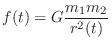
where
 is the distance between the centroids of the masses
and at time
is the distance between the centroids of the masses
and at time  , and
, and  is the gravitation
constant.B.2
is the gravitation
constant.B.2
The law of gravitation Eq. (B.2) can be accepted as an
experimental fact which defines the concept of a force.B.3 The giant conceptual leap taken by Newton was that the law of
gravitation is
universal--applying to celestial bodies as well as objects on
earth. When a mass is ``dropped'' and allowed to ``fall'' in a
gravitational field, it is observed to experience a
uniform acceleration proportional to its mass. Newton's second
law of motion (§B.1) quantifies this result.
(B.2) can be accepted as an
experimental fact which defines the concept of a force.B.3 The giant conceptual leap taken by Newton was that the law of
gravitation is
universal--applying to celestial bodies as well as objects on
earth. When a mass is ``dropped'' and allowed to ``fall'' in a
gravitational field, it is observed to experience a
uniform acceleration proportional to its mass. Newton's second
law of motion (§B.1) quantifies this result.
Next Section:
Hooke's Law
Previous Section:
Mass