Ideal Differentiator (Spring Admittance)
Figure 8.1 shows a graph of the frequency response of the
ideal differentiator (spring admittance). In principle, a
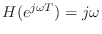
digital differentiator is a filter whose frequency response
 optimally approximates
  for
for  between
  and
and  . Similarly, a digital integrator must
match
. Similarly, a digital integrator must
match  along the unit circle in the
  plane. The reason
an exact match is not possible is that the ideal frequency responses
and , when wrapped along the unit circle in the
plane, are not ``smooth'' functions any more (see
Fig.8.1). As a result, there is no filter with a
rational transfer function (i.e., finite order) that can match the
desired frequency response exactly.
plane. The reason
an exact match is not possible is that the ideal frequency responses
and , when wrapped along the unit circle in the
plane, are not ``smooth'' functions any more (see
Fig.8.1). As a result, there is no filter with a
rational transfer function (i.e., finite order) that can match the
desired frequency response exactly.
![\includegraphics[scale=0.9]{eps/f_ideal_diff_fr_cropped}](http://www.dsprelated.com/josimages_new/pasp/img1805.png) |
 of the ideal digital differentiator plotted over
the unit circle in the
of the ideal digital differentiator plotted over
the unit circle in the
The discontinuity at  alone is enough to ensure that no
finite-order digital transfer function exists with the desired
frequency response. As with bandlimited interpolation (§4.4),
it is good practice to reserve a ``guard band'' between the highest
needed frequency
alone is enough to ensure that no
finite-order digital transfer function exists with the desired
frequency response. As with bandlimited interpolation (§4.4),
it is good practice to reserve a ``guard band'' between the highest
needed frequency
 (such as the limit of human hearing) and half
the sampling rate
(such as the limit of human hearing) and half
the sampling rate  . In the guard band
![$ [f_{\mbox{\tiny max}},f_s/2]$](http://www.dsprelated.com/josimages_new/pasp/img1807.png) , digital
filters are free to smoothly vary in whatever way gives the best
performance across frequencies in the audible band
, digital
filters are free to smoothly vary in whatever way gives the best
performance across frequencies in the audible band
![$ [0,f_{\mbox{\tiny max}}]$](http://www.dsprelated.com/josimages_new/pasp/img1808.png) at the
lowest cost. Figure 8.2 shows an example.
Note that, as with filters used for bandlimited
interpolation, a small increment in oversampling factor yields a much
larger decrease in filter cost (when the sampling rate is near
at the
lowest cost. Figure 8.2 shows an example.
Note that, as with filters used for bandlimited
interpolation, a small increment in oversampling factor yields a much
larger decrease in filter cost (when the sampling rate is near
 ).
).
In the general case of Eq. (8.14) with
  , digital filters
can be designed to implement arbitrarily accurate admittance transfer
functions by finding an optimal rational approximation to the complex
function of a single real variable
, digital filters
can be designed to implement arbitrarily accurate admittance transfer
functions by finding an optimal rational approximation to the complex
function of a single real variable 

 , where
 is the upper limit of human hearing. For small guard
bands
is the upper limit of human hearing. For small guard
bands
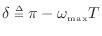 , the filter order required for a
given error tolerance is approximately inversely proportional to
, the filter order required for a
given error tolerance is approximately inversely proportional to
 .
.
Next Section:
Digital Filter Design Overview
Previous Section:
Relation to Finite Difference Approximation